Tag: AMOLED

  • Garmin Fenix 8 47mm AMOLED Review: What Happened When I Needed Glasses for the First Time

    Garmin Fenix 8 47mm AMOLED Review: What Happened When I Needed Glasses for the First Time

    This post contains affiliate links. If you buy through them I may earn a small commission, at no extra cost to you.

    This is my Garmin Fenix 8 AMOLED review, written after six months of daily use. Twelve months ago I was awake at 3am, reading watch reviews in the dark, trying to work out whether there was a watch bright enough to solve a specific problem I had. I had recently had a cataract operation and, for the first time in my life, I needed glasses to read. Fine at a restaurant. Significantly less fine when I was running, climbing or sailing and needed to check my heart rate without stopping to fumble around for my specs. This is what I found, and six months on, whether I was right.

    I had the cataract operation in 2024. Nobody really tells you what happens after. One of the side effects for me was needing reading glasses for the first time in my life at 55. Restaurant menus, small print, my old Fenix 7. Suddenly all a bit of a squint.

    Which created an annoying problem. When you are running, cat sailing or halfway up an indoor climbing wall, you do not want to be fumbling for glasses just to check your heart rate.

    My Fenix 7 was a watch I genuinely loved, but the screen was perfectly fine before the op and then just was not bright enough anymore. So when my girlfriend Suzy bought me the Garmin Fenix 8 47mm AMOLED Sapphire for my birthday last December, I was not just excited about a new watch. I was hoping it would solve a real, everyday problem.

    Six months in. Here is the honest verdict and everything I have learnt about this watch since.

    A bit of background on the Fenix

    The Garmin Fenix line has been around since 2012, and it has always been built for one type of person: serious outdoor athletes who need a watch that will not die on them halfway up a mountain, across a lake or through a triathlon. Think climbers, trail runners, sailors, divers, triathletes. It is built to military grade durability standards and the price reflects that.

    The Fenix 8 launched in August 2024 and brought the biggest changes in years: a built in speaker and microphone, a proper LED flashlight and, most importantly for me, a choice between an AMOLED display or solar charging.

    I went for the 47mm AMOLED Sapphire in DLC titanium with the carbon grey strap. Two reasons. The AMOLED screen is the bright one, and given my eyesight that was the whole point. And the DLC titanium with sapphire glass is the tough one. Between climbing walls and salt water, my watches take a battering, so I wanted both the case and the glass to be as close to indestructible as money sensibly buys.

    Garmin Fenix 8 47mm AMOLED Sapphire on Amazon

    Did it solve the glasses problem? Yes.

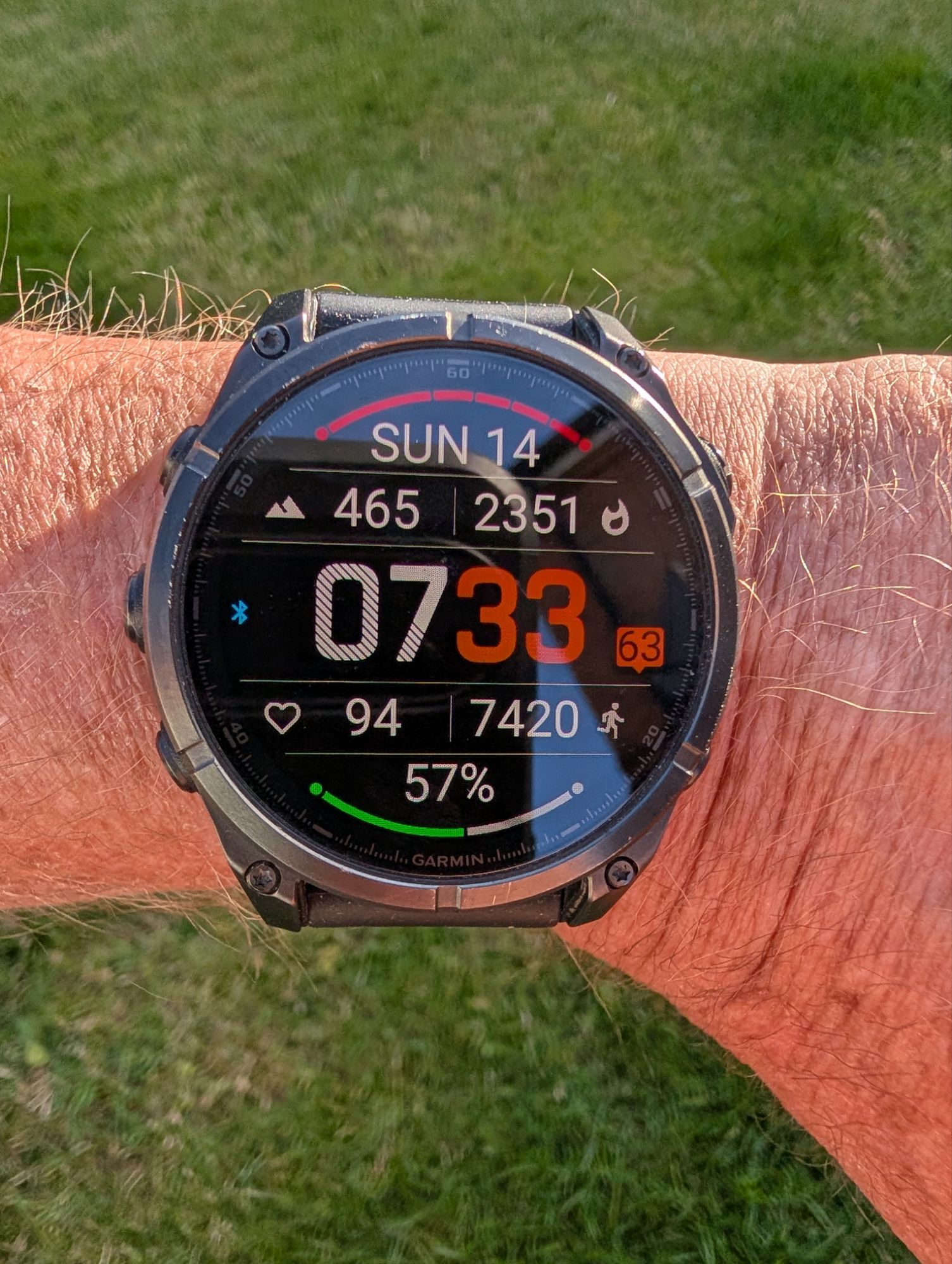
    This is the headline for anyone in the same boat as me. The AMOLED screen is bright, sharp and high contrast in a way the older transflective screens simply are not. I can read a restaurant menu only with my glasses on, but I can read this watch at a glance, in daylight, mid run, without them. For me that is not a nice to have. That is the entire reason I own it.

    If your eyes have changed and you have been quietly struggling to read your current watch, this one detail is worth the upgrade on its own.

    Sailing the Nacra Inter 20

    This is where the Fenix 8 has genuinely surprised me. I sail a Nacra Inter 20 cat, and the watch has become part of the kit.

    At a glance I can see how fast I am going and how far I have sailed, which sounds simple but is exactly what you want when both hands are busy and the boat is moving. For races it has been excellent. I can set up navigation for the longer distance stuff and use the countdown timer for the starts, which takes a surprising amount of faff out of race day.

    Salt water, spray, the odd capsize. Six months in and the DLC case and sapphire glass have shrugged all of it off without a mark.

    Indoor climbing: good, not perfect

    I will be honest here, because honest is the whole point of this blog. For indoor climbing the Fenix 8 is fine, but it is actually a small step back from my old Fenix 7 for the way I like to log climbs.

    If I want to record the difficulty of each climb, I have to stop the activity, save it, and start a new one every single time. That is more stopping and starting than I can be bothered with mid session. So I have stopped fussing. I start one activity at the beginning of a climbing session and let it run, and treat it as a record of calories and number of climbs rather than a route by route log.

    Fortunately it does not measure how much coffee I drink between climbs. I just let it run and enjoy the session.

    Running: as good as you would expect

    For running it is, predictably, bloody brilliant. I do not exploit even half of what it can do, and it is still the best running watch I have owned. Accurate GPS, a screen I can actually read without glasses, and battery life that means I am not thinking about charging it every five minutes.

    I pair it with Komoot for planning and following routes when I am out walking and exploring new ground, and the two work together nicely. The watch handles the live navigation and Komoot handles the planning the night before, usually at 3am.

    [AFFILIATE LINK: Komoot]

    Sleep tracking and HRV: the bit I did not expect to care about

    I bought this watch for the screen. The sleep tracking was not even on my list of reasons. Six months later it is the thing I check most mornings before I get out of bed.

    The HRV data is the thing I find most genuinely useful. Mine drops noticeably before I come down with a cold. Not the morning I feel rough, but a day or two before, when I still feel fine. The watch knows something is brewing before I do. Once you have spotted that pattern a few times it becomes properly useful. I now treat a low HRV morning as a signal to take it easy rather than smash a run, and I am fairly sure that has shortened a few illnesses that would otherwise have floored me.

    Diet shows up in it too. A takeaway or a night of eating badly will pull my HRV down the next morning just as clearly as a virus does. It is not a perfect instrument, because stress, alcohol, sleep quality and a hundred other things all affect it, but as a daily signal that tells you whether your body is in a good state to push hard or needs a recovery day, it is more useful than any subjective sense of whether you feel ready.

    Garmin’s Body Battery metric rolls all of this together into a single number, which I find more actionable than looking at HRV on its own. A Body Battery of 90 in the morning means push it. A Body Battery of 40 means something is going on, even if you are not sure what yet. Over time you learn what your normal range looks like and what pulls it down.

    For a genuine insomniac, having actual data about sleep rather than just a vague sense of having slept badly is worth something. I know how many hours I got, roughly what quality, and whether my body recovered overnight or is still running a deficit. That is not nothing at 3am when you are lying awake wondering if the four hours you got will be enough.

    A note on the wider Garmin picture

    The Fenix 8 feeds into the same Garmin Connect picture as the rest of my kit, and that is part of why I have stuck with the ecosystem. Alongside the watch I use a set of Hume Pod scales for weight and body composition, and a Hilo blood pressure monitor for continuous wrist BP readings. I recently wired all three into Claude to read them together. What it found is in this post about joined-up health data. It also comes with me in the Giottiline Giottivan on every trip.

    I have reviewed the Hume Health Pod separately if you want the full detail on how it works alongside the Fenix 8.

    Garmin Fenix 8 AMOLED review verdict: should you buy one?

    If you are an outdoor type in your fifties whose eyes have started to change, the AMOLED screen alone makes a genuine case for the upgrade. If you sail, the navigation and start timers are excellent. If you climb and you like a route by route log, just know that the activity switching is a minor faff.

    It is not cheap. But I bought into it as a long term piece of kit, not a gadget, and six months in it has earned its place. I would buy it again tomorrow. You can find it on Amazon here. If you have managed blood pressure and want to pair the watch with continuous wrist readings, the Hilo blood pressure monitor works well alongside it as part of a joined-up daily health picture.


    pharrison131 Avatar

    Pete Harrison

    I’m Pete Harrison. I’m 55, I run a business, and I have a mild case of insomnia that means I spend a lot of time at 3am reading about gadgets, gear and ways to make life work better. Things I Learnt at 3am is where I write honestly about the things I’ve actually bought, tested and lived with. No fluff, no rehashing the spec sheet. Just the real verdict from someone who uses this stuff every day.