This post contains affiliate links, marked where they appear. If you buy through one I may earn a small commission at no extra cost to you. Read on before you do, because I am about to spend fifteen hundred words telling you it did not work for me.
It is 3am and I am looking at a spreadsheet that tells me I have spent about forty quid on beetroot and a month of pulling a face at seven in the morning, and got precisely nothing for it. Which is, annoyingly, exactly the outcome I said I would publish if it happened.
So here it is. The beetroot juice blood pressure trial I pre-registered back in June is finished, and the answer is no.
The result, before anything else
My daytime resting blood pressure before the trial was 133/85. My daytime resting blood pressure during the trial was 133/85.
Not close to it. Not within a point of it. The same number.
| Period | Systolic | Diastolic | Readings |
|---|---|---|---|
| June, before beetroot | 133 | 85 | approx 400 |
| July, on beetroot | 133 | 85 | 559 |
| Difference | 0 | 0 |
I said in the protocol, before I drank any of it, that I would call a 3 mmHg drop in systolic pressure a signal worth taking seriously. That number was not plucked out of the air. It is roughly the low end of what the published research on dietary nitrate reports, and I wanted to commit to a threshold before I had any data, so that I could not quietly move the goalposts later.
I got zero. Not 2 mmHg that I could squint at and call promising. Zero.
What I actually did
One shot of Beet It Sport Nitrate 400 every morning, starting on 25 June and finishing on 27 July when the supply ran out. That is 33 days, not the 30 I pre-registered, because a box does not divide neatly into a calendar and I was not going to throw the last three away.
I am flagging that deviation rather than rounding it down to 30 and hoping nobody checks. Three extra days in the same direction does not change the conclusion, but the entire point of writing the protocol down first was that I would have to own the bits that did not go to plan.
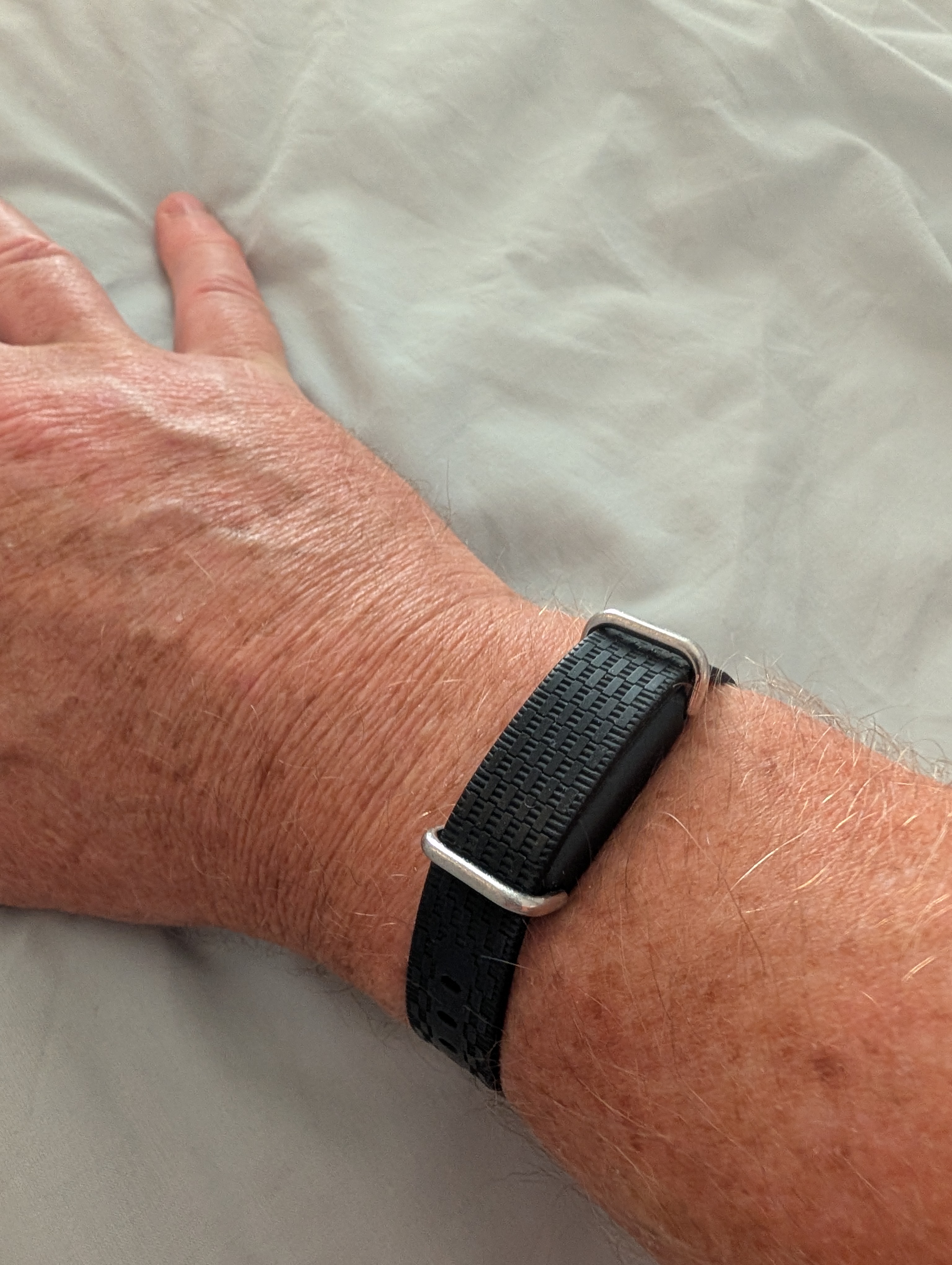
Throughout, I wore the Hilo band continuously, as I have for two years. It takes readings on its own through the day and night without me doing anything, which is the whole reason this experiment was possible at all. A cuff would have given me one number a day taken at whatever moment I happened to remember. This gave me 824.
I went looking for the effect anyway
A single monthly average can hide things. An effect that built slowly, or faded, or only showed up in the first fortnight, would all average out to nothing. So I broke the whole month down week by week using every single reading, day and night, rather than the headline figure.
| Week | Mean systolic | Readings |
|---|---|---|
| 1 to 7 July | 128.1 | 196 |
| 8 to 14 July | 129.1 | 218 |
| 15 to 21 July | 128.6 | 202 |
| 22 to 27 July | 128.4 | 208 |
One millimetre of mercury of spread across four weeks, with no direction to it. The first ten days averaged 128.2 and the last ten days averaged 128.3.
There is no effect hiding in there. There is no slow build. There is nothing to salvage.
What this does not mean
It does not mean beetroot does nothing for anyone. The research on dietary nitrate is real and I went through it properly in a separate reference piece before I started. What the studies mostly show is a modest effect, often larger in people who are not already medicated and not already being managed.
I am neither of those. I have been on blood pressure medication since 2005 and I currently take lercanidipine and ramipril. It is entirely plausible that those are already doing the thing beetroot is supposed to do, and that there was simply no room left for it to work. That is a real explanation and I am not going to pretend it is not.
It is also worth saying plainly what this study is. One person. No placebo. No blinding. No randomisation. I knew exactly what I was drinking and when, and I knew what I was hoping to see. Against that, the only real defences are that the measurement was automatic rather than something I chose to take when I felt like it, that the threshold was set in public before any data existed, and that there were 824 readings rather than a handful.
The limitations I have to declare
There was no upper arm cuff cross-check running alongside this. I disclosed that in the protocol and it stands as the biggest weakness. The Hilo calibrates monthly against a cuff, so it is not floating free, but I was not taking independent cuff readings in parallel to verify the trend.
July was not a controlled month either. It was hot and we were away in the van twice. What it was not, and I checked this properly rather than guessing, is a month where my training fell apart. I ran 17 times during the dosing period, covering 134 kilometres in a little over 19 hours, which is three or four steady runs a week. That is about as consistent as I get. If anything the training got harder towards the end: my four fastest runs of the whole period all fall in the last ten days, averaging 7 minutes 53 per kilometre against 8 minutes 13 earlier in the month, and at a higher average heart rate to go with it. So the exercise side of my life was not quietly cancelling out a beetroot effect. It was, if anything, pointed the same way the beetroot was supposed to be, and the number still did not move.
The last three days did run slightly higher, at 130.7 systolic against 128.6 for the month. I am not going to build a story out of that. It sits inside the normal daily spread, where individual days ranged from 124.3 to 132.6 throughout.
On the affiliate link
I have left the link to the product in this post, and I want to be straight about why.
One person’s result is not evidence about yours, and the published research is genuinely more encouraging than my month was, particularly for people who are not medicated. If you have read all of that and want to try it, the link is there and it works.
But I would rather you did not buy it because of me. I ran this properly and it did nothing, and quietly deleting the link so the failure looks tidier would be its own kind of dishonesty. So it stays, with the result attached to it.
What happens next
The protocol called for a 14 day washout after the last dose, which takes it to 10 August. I am still wearing the band, so that data is collecting itself whether I think about it or not.
Honestly, I expect it to show nothing, because you cannot wash out an effect that never arrived. But I said I would publish it, so I will, and if it surprises me then that will be the more interesting post of the two.
Was it worth doing
Forty pounds and a month of mornings, for an answer of no.
Yes, though. Before this I had a vague sense that beetroot was one of those things that probably helped a bit, picked up from headlines and supplement adverts at 3am. Now I know what it does for me specifically, which is nothing, and I can stop wondering about it and stop buying it.
That is worth forty quid. The band that measured it cost rather more, and this is the clearest example I have had yet of why I wear it.
None of this is medical advice. I am a bloke with a spreadsheet and a wrist band, not a doctor. Do not change any medication on the strength of a blog post. Talk to your GP.
I publish the ones that fail too
I test things on myself properly, write down what I expect to find before I start, and publish the answer either way. Subscribe and I will send you the next one, working or not.
I’m Pete Harrison. I’m 55, I run a business, and I have a mild case of insomnia that means I spend a lot of time at 3am reading about gadgets, gear and ways to make life work better. Things I Learnt at 3am is where I write honestly about the things I’ve actually bought, tested and lived with. No fluff, no rehashing the spec sheet. Just the real verdict from someone who uses this stuff every day.