This post contains affiliate links. If you buy through them I may earn a small commission, at no extra cost to you.
I was awake at 3am looking at body composition scales because I had just stepped off my old Renpho and watched the body fat reading drop in perfect proportion to my weight. I knew immediately it was useless. It was telling me nothing. All it was doing was applying a formula to my weight and calling it data. I wanted actual data.
This is my Hume Health Pod review, written after long-term daily use. The short version: it is the first scale I have owned that I actually trust.
Why I ditched the cheap smart scale
The Renpho was about £30 on Amazon. It looked impressive in the app. It showed me body fat, muscle mass, bone density, all the numbers. The problem was that every single metric moved in direct proportion to my weight. Lose a kilo, every number improved. Put it back on, every number worsened. That is not body composition analysis. That is just weight with extra steps.
I started reading about what actually separates a decent body composition scale from a cheap one. The answer, consistently, was how many electrodes it uses and how many frequencies it scans at. Most budget scales use two electrodes, foot to foot, measuring only through your lower body and estimating the rest. More expensive clinical equipment scans at multiple frequencies across multiple pathways simultaneously. The Hume Health Pod does the latter.
How the Hume Health Pod actually works
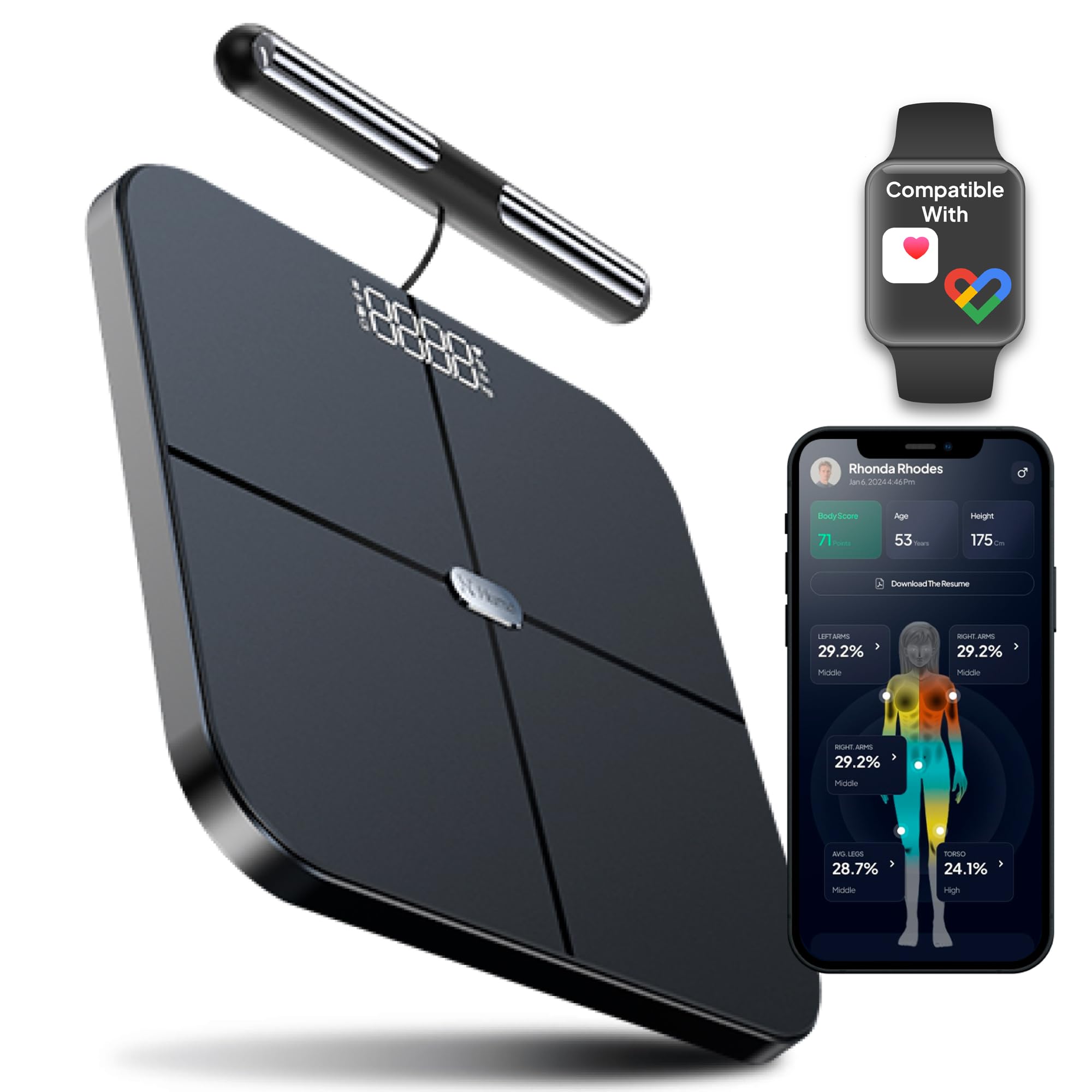
You stand on the platform and hold a bar. That bar matters. Most scales only measure from foot to foot, which means they are only looking at your lower body and extrapolating everything else. The Hume Pod uses eight electrodes, four in the platform and four in the handle, scanning across your arms, torso and legs separately. It runs at multiple frequencies from 20kHz to 100kHz, which allows it to distinguish between fluid inside and outside your cells, giving a much more accurate picture of fat versus muscle versus water.
The result is segmental analysis. Not just a single body fat percentage, but a breakdown by body part. This matters because you might have good overall numbers but be carrying fat in one area or lacking muscle in another. My data shows that clearly. My lean mass is slightly below expected for my height and weight, while my body fat is slightly above. Knowing that is actionable. A number on a bathroom scale is not.
The accuracy question, and what Bluecrest confirmed
I had a medical health check with Bluecrest Health Screening. One of the things they measured was body composition. When I compared their results to the Hume Health Pod readings from around the same period, they were remarkably close. That was the moment I stopped treating the scale as approximate and started treating it as a genuine data source.
Hume claim 98% accuracy and have had the device independently validated by Socotech against DEXA scan results, DEXA being the gold standard clinical measurement used in hospitals. That validation is what sets it apart from the dozens of scales that simply claim accuracy without any third-party testing behind it.
My Hume Health Pod stats, and what they actually mean

Here is where I am right now. I am 55. My health score is 662, rated High. My biological age comes out at 47, eight years younger than I actually am. My metabolic age is 42 to 44 depending on the reading, which is rated Excellent, 11 to 13 years below my chronological age. I weigh 95.9kg.
Body composition: lean mass 71kg, body fat mass 21kg, body fat percentage 22.1%, skeletal muscle mass 48kg, average water level 58%. Lean mass is Standard but 2kg below expected. Body fat is Standard but 7kg above expected for my frame.

What does that mean for someone trying to stay fit at 55? My aerobic fitness and metabolic health are in good shape. The Garmin Fenix 8 data backs this up with VO2 max and Body Battery metrics that have been consistently strong. But I am carrying more fat than I should be for my frame, and my lean mass is slightly lower than ideal. The practical implication is straightforward: prioritise protein and resistance work to protect and build muscle mass, while the fat comes down through activity and diet. I recently ran all of this data through Claude, the Hume numbers alongside the Hilo and Garmin, and what it found was revealing. The full story is in this post about what happens when you read all your health gadgets at once.
It also connects via Google Health Connect to import your Garmin data, so the Garmin Fenix 8 and the Hume Pod give you a joined-up picture of fitness and body composition in one place. Same works for Apple Health if you are in that ecosystem.
The app and what it is still developing

The Hume app is good and clearly being actively improved. There are sections, Activity and Sleep, currently showing a message saying they are being refined and will return shortly. That tells you the company is still building, and they would rather take something offline than leave it half-finished. I find that reassuring. The body composition data has always been there and has always been accurate. Everything else is a bonus.
The app remembers up to 30 users, making it genuinely family-friendly. Weekly health reports are well-designed and show the trend data over time. That longitudinal view is where the real value is. Not any single reading, but the direction of travel over weeks and months.
What about the Hume Band?
Hume also sell a wearable band that adds cardiovascular score, sleep architecture and recovery data. I have not bought it. I already have the Fenix 8 doing all of that, and I do not need to duplicate it. If you do not have a capable wearable, the band would round out the picture considerably. For me, the Pod alone is the right call.
Pricing: they never charge full price
They never charge full price. That is not cynicism. It is just how they operate. There is almost always a promotion running or a discount code available. If you see it at full price, wait a week. Or use my link which gets you money off straight away: humehealth.com/PETER22195. I would not pay full price and you do not need to.
Hume Health Pod review verdict: would I buy it again?
Yes, without hesitation. It is the first scale I have owned where I trust the data enough to make decisions based on it. The Bluecrest comparison confirmed it. The app is improving constantly. And the integration with Garmin via Google Health Connect means it sits neatly inside the same health picture I am already building with the Hilo blood pressure monitor and the Fenix 8.
If you are over 50 and thinking seriously about your health, and by that I mean not just your weight but your actual body composition, your muscle mass and your fat distribution, then a decent scale is not a luxury. It is the starting point. The Hume Health Pod is the one I would recommend. Just make sure you get it with a discount. Use this link and you will.

About the author: I’m Pete Harrison. I’m 55, I run a business, and I have a mild case of insomnia that means I spend a lot of time at 3am reading about gadgets, gear and ways to make life work better. Things I Learnt at 3am is where I write honestly about the things I’ve actually bought, tested and lived with. No fluff, no rehashing the spec sheet. Just the real verdict from someone who uses this stuff every day.
