Disclosure, and there are two things to declare here. This book was a present from my girlfriend Suzy, and the author is a friend of hers. Suzy bought it herself and the author has no idea she did, or that I have written this. Separately, the link below is an Amazon affiliate link, so if you buy through it I earn a small commission at no cost to you. Weigh what follows knowing both of those things.
At about ten past three one morning I was working out whether I could run a Bitcoin mine off the roof of a house in Flintshire.
I had not gone to bed intending to do that. I had gone to bed with a book about disputed territories in eastern Europe, which is a different sort of thing entirely. That is the trouble with Hinterlands. It does not stay where you put it.
What the book actually is
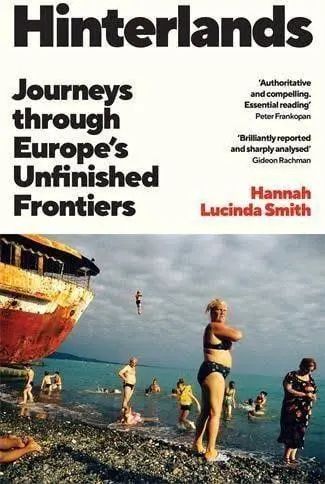
Hinterlands: Journeys Through Europe’s Unfinished Frontiers came out on 4 June 2026, published by Profile, 288 pages in hardback.

Hannah Lucinda Smith is a foreign correspondent who has written for The Times and The Economist and has spent well over a decade reporting from the region rather than parachuting into it. There is a US edition with a blunter title, The New Cold War Brewing at the Peripheries of the West, which tells you something about how two markets are being sold the same argument.
Seven chapters, seven places. Syria, Cyprus, Bosnia, Kosovo, Transnistria, Crimea, Nagorno-Karabakh. Disputed territories, breakaway republics, frozen conflicts, places that appear on some maps and not others.
The argument underneath is that these are not backwaters where nothing happens. They are where the next thing happens first, while the West is looking somewhere else.
Why Suzy thought I would like it
Because she pays attention, which is more than can be said for most people choosing books for other people.
I have spent years being drawn to the parts of Europe that most holidays skip. Russia, Georgia, Ukraine including a day inside the Chernobyl exclusion zone, Poland, Romania, Bulgaria, Hungary, and Berlin more times than I can properly account for. The Cold War and what it did to those countries afterwards has interested me since long before it became a live topic again.
So this was aimed squarely at me. What I did not expect was how much of it would be about people rather than politics.
The bit that makes it work
It would have been easy to write this as a geopolitics book. Maps, treaties, acronyms, the names of foreign ministers nobody outside the region has heard of.
Smith does not do that. The chapters are built around conversations with actual people who live in these places. Politicians and fixers, yes, but mostly ordinary people getting on with ordinary lives in territories that officially should not exist. People whose passports are not recognised, whose houses sit the wrong side of a line drawn by somebody else, who have organised an entire life around a dispute they had no part in starting.
That is what makes it readable rather than worthy. I got through it quickly, which for a book about frozen conflicts in the Caucasus is not a given.
Cyprus, and the holiday I did not understand at the time
The Cyprus chapter landed differently for me, because I have holidayed in the northern part of the island.
You go for the coast and the food and the ruins, and you are dimly aware that something happened here, and then you come home. Reading this chapter I realised how thin my understanding of it actually was.
The short version. Cyprus became independent from Britain in 1960, with a constitution that shared power between the Greek and Turkish Cypriot communities and named three guarantor powers: Britain, Greece and Turkey. That arrangement broke down within three years. Intercommunal violence through 1963 and 1964 pushed Turkish Cypriots out of the government and into enclaves, and United Nations peacekeepers arrived in 1964. They are still there, sixty years later, which tells you how well the problem got solved.
Then July 1974. The Greek military junta backed a coup by the Greek Cypriot National Guard, which deposed President Makarios with the aim of union with Greece. Five days later Turkey invaded, citing its rights as a guarantor power. By the time the second phase finished in August, Turkey held roughly a third of the island.
Something like a hundred and sixty thousand Greek Cypriots moved south and around fifty thousand Turkish Cypriots moved north, most of them leaving houses they never went back to. In 1983 the north declared itself the Turkish Republic of Northern Cyprus. Turkey is the only country on earth that recognises it. The British government does not.
In 2004 a United Nations settlement plan went to referendum on both sides. Turkish Cypriots voted for it. Greek Cypriots voted against it by about three to one. Cyprus joined the European Union a week later, still divided, and it has stayed that way ever since.
I ate dinner about forty minutes from a fenced-off suburb of Famagusta that has stood empty since 1974 and thought no more about it. That is what this book keeps doing. It goes back over ground you thought you had already covered and shows you that you had not.
Transnistria, and money made out of gas nobody pays for
The chapter I keep coming back to is Transnistria, partly because it is the one place in the book I might realistically get to. Moldova has been on my list for years.
It is a thin strip of land along the eastern bank of the Dniester, wedged between the rest of Moldova and Ukraine. Under the Soviet Union it held most of the Moldavian republic’s industry and power generation, and its population was far more Russian and Ukrainian than the rest of the country.
The trigger was language. In 1989 Moldova made Moldovan the state language and moved it back to the Latin script from Cyrillic, which to the Russian speakers on the east bank looked like the first step towards Moldova merging into Romania. In September 1990 the strip declared itself a separate republic. Moldova declared independence from the Soviet Union in August 1991, and by March 1992 the two were at war.
It lasted about four months and killed somewhere around a thousand people. What settled it was the Soviet 14th Army, which happened to be stationed there and which intervened on the Transnistrian side. There has been a ceasefire since July 1992 and Russian troops have been there ever since. No United Nations member state recognises Transnistria. It has its own currency, its own border guards, its own football team, and a great deal of Soviet statuary nobody ever took down.
The detail that got me was the cryptocurrency mining, and the reason it works there is worth setting out properly.
Transnistria receives Russian gas and does not pay for it. The bill is added to the arrears of Moldovagaz in Chisinau, arrears running to hundreds of millions of dollars that nobody seriously expects to be settled. That effectively free gas fires the Cuciurgan power station, a Soviet-era plant of around 2,500 megawatts that Transnistria inherited when most of Moldova’s generating capacity ended up on the wrong side of the line.
So you have one of the poorest corners of Europe sitting on an enormous amount of nearly free electricity and not enough industry left to use it. In 2018 it legalised crypto mining, waived import duties on the machines and exempted mining income from tax. A state technopark now sells miners power at somewhere around four cents a kilowatt hour.
A Russian subsidy designed to keep a breakaway region afloat, converted through a Soviet power station into Bitcoin. I did not know that was a thing.
Which is how I ended up costing up a mine in North Wales
Here is where a book about the Caucasus turned into me doing arithmetic in the dark.
The obvious thought, once you understand why Transnistria works, is whether you could do a small honest version of it. Not free gas, obviously. But I have looked at solar before, sunlight is free once the panels are paid for, and if the whole game is cheap electricity then surely there is a version that stacks up.
There is not. It is not close.
Start with the comparison. That Transnistrian technopark rate of about four cents works out somewhere near three pence a kilowatt hour. Under the Ofgem cap from 1 July 2026, electricity in England, Scotland and Wales on a standard variable tariff by direct debit is 26.11 pence a kilowatt hour. Roughly eight times more. UK electricity is now more expensive than almost anywhere in the EU, which is its own depressing rabbit hole for another night.
Then the solar arithmetic, which is where it properly falls apart. A single modern mining machine pulls somewhere around three to three and a half kilowatts, and it wants to do that continuously, because the hardware is only worth owning if it is working. Over a year that is roughly thirty thousand kilowatt hours.
A typical domestic solar array in Britain produces something in the region of three to four thousand kilowatt hours a year. So a full roof generates roughly a tenth of what one machine wants, generates it at the wrong times of day, and generates almost none of it between November and February.
You would need batteries to run overnight, and the batteries cost more than the mining earns. Run it off the grid instead and you are buying electricity at 26p to produce something worth less than the electricity. That is before the machine screams like a hairdryer at around 75 decibels and pumps three kilowatts of heat into a room in August.
So the answer is no. Micro mining does not work in this country, and the reason Transnistria works is not clever engineering or a smart regulatory regime. It is that somebody else is paying for the gas. You cannot replicate free.
That was two hours of a night I am not getting back, and I would do it again.
Could you actually go to either of them
This is where I went next, because a book like this makes you want to look at flights. The two places I know best from it turn out to sit at opposite ends of the difficulty scale.
Northern Cyprus is genuinely easy, and I have done it. You can fly into Larnaca or Paphos in the Republic and cross at one of the designated checkpoints with your passport, including on foot at Ledra Street in the middle of Nicosia, which is a strange thing to do on an ordinary afternoon. The one rule people get caught by is that if you fly into the north instead, via Turkey, you have to leave via the north too.
What is worth knowing is what you give up. Britain does not recognise the north, so the Foreign Office can only offer limited consular help there, and the authorities in the north do not share information with the British High Commission about where British nationals are or how they are being treated. Documents issued in the north are not recognised by the Republic. None of that spoils a holiday, but it is not nothing, and I did not know any of it when I went.
Transnistria is a different matter, and I want to be straight about it rather than romantic.
Mechanically it is simple. British citizens need no visa for Moldova for a short stay, Tiraspol is a couple of hours from Chisinau by bus or car, and you fill in a migration card at a checkpoint that is not an international border and get a slip of paper you must not lose.
But the Foreign Office advises against all travel to Transnistria, and has done since 2022. Its reasoning is worth reading rather than skimming. The territory is outside Moldovan government control, British consular support there is extremely limited, all crossings between Transnistria and Ukraine are closed, and the local parliament has expanded its powers of prosecution and pre-trial detention against people it considers extremists, a definition that stretches to things a British visitor would think of as ordinary speech.
There is also the practical point that travelling against Foreign Office advice generally invalidates your travel insurance.
Plenty of people still go, and come back with photographs of Lenin outside the parliament building. I would still like to see Moldova. I am not going to pretend the sliver on the far bank is a normal weekend break, and this is one of the places where the book being interesting and the place being sensible to visit are two different questions.
The rock in the introduction
The thing that first sent me off looking is not one of the seven chapters. It is in the introduction, and it is Rockall.
Rockall is an eroded volcanic plug about 260 miles west of the Western Isles and roughly 230 nautical miles north west of Donegal. It is about thirty metres wide and twenty metres high. Nobody lives there and nobody could. In 1955 a party of Royal Marines landed, raised a flag, claimed it for the Queen and cemented a plaque into it. In 1972 the Island of Rockall Act formally made it part of Scotland’s Western Isles.
Ireland has never accepted any of this. Not because Ireland wants Rockall, but because it argues that an uninhabitable rock cannot generate a territorial sea at all. Iceland and Denmark, on behalf of the Faroes, have had their own views over the years.
None of which mattered much until it did. After Brexit, Scotland began enforcing a twelve mile limit around the rock. In January 2021, days after the transition period ended, a Marine Scotland patrol vessel boarded an Irish trawler out of Greencastle in Donegal and told it to leave waters its crew had fished for generations. Irish boats had traditionally worked those grounds for haddock and squid. The dispute is still unresolved, and the seabed out there is thought to hold oil and gas as well as fish.
Putting that in the introduction is a smart move, and I only worked out why afterwards. Before you have gone anywhere near the Caucasus, you have been shown that Britain has its own unfinished frontier, argued over with its nearest neighbour, involving a rock nobody can live on and a great deal of fish. It stops the whole subject being something that happens to other people somewhere else.
The honest criticism
Seven disputed territories in 288 pages is not a lot of pages each.
Every chapter left me wanting considerably more than it gave, and I do not entirely mean that as a compliment. Some of it is the nature of the thing, since a book doing full justice to Nagorno-Karabakh alone would be a book about Nagorno-Karabakh. But there were chapters where I felt I had been shown a door rather than taken through it.
The counter-argument is that the doors are the point, and my search history for the fortnight after finishing it rather proves the case. Still, if you want depth on one particular place, this is a starting point and not a destination.
It is also a snapshot of a fast-moving region, and Syria in particular has not stood still. That is an inevitability rather than a flaw, but read it knowing the ground shifts.
And it is not a travel book. If you were hoping for practical detail on actually getting into Transnistria, that is not what this is. I had to go and find all of that myself, which is how I ended up reading Foreign Office advisories at midnight.
Would I recommend it
Yes, and not out of politeness.
If you have any interest in the former Soviet Union, in the Cold War and what it left behind, or in how borders actually get made and unmade rather than how they look on a map, you will get through Hinterlands quickly and then spend a fortnight reading around it.
If you have no particular interest in any of that, I am not sure it converts you. It does not spend much effort persuading you to care before it starts, which I liked, but it does assume you turned up already curious.
I turned up already curious. Suzy knew that. She usually does.
If you want something completely different from the same shelf, I also wrote about The Winter of Frankie Machine, which has no disputed territories in it whatsoever.
I’m Pete Harrison. I’m 55, I live in Buckley in North Wales, and I have a mild case of insomnia that means I spend a lot of time at 3am reading about things I did not know existed that morning. Things I Learnt at 3am is where I write honestly about what I’ve actually bought, read, tested and lived with.
Leave a Reply