This post contains affiliate links, marked where they appear, to gear I’ve bought with my own money and use every week. If you buy through them I may earn a small commission at no extra cost to you.
It’s 3am and I can’t sleep, running through a kit list for a caravan we’re not driving to for another couple of weeks yet. Climbing shoes. Harness. Chalk bag. We’re going back to Nant Bychan Farm on Anglesey, the site I only just wrote up properly, and a wet day there two summers ago is the entire reason any of that kit exists at all.
A long way from comfortable with heights
I used to have a genuinely debilitating fear of heights. I beat it over a period of years by doing the one thing that felt most stupid at the time, deliberately putting myself in front of every precipice I could find. My theory was simple. The moment something becomes routine and boring, you’ve overcome it. I don’t know if that’s an established idea with a proper name, exposure therapy in some informal, self-administered form perhaps, but it worked for me, slowly and without any drama.
Two specific things still kept me wary of climbing itself, though, long after general heights stopped bothering me.
The first was a climbing lesson on a sea cliff in Pembrokeshire. It felt properly unsafe, not because anything went wrong, but because the sea was directly below me the entire time and my brain never fully accepted that the rope was doing its job.
The second was Crib Goch. If you don’t know it, Crib Goch is the narrow, knife-edge ridge that forms the first leg of the Snowdon Horseshoe in Eryri, technically a scramble rather than a climb, but with drops on both sides sharp enough that plenty of experienced hillwalkers give it a wide berth. My attempt went wrong before I even reached the ridge itself. I ended up lying on what felt like a near-vertical scree slope, so committed to staying attached to the hillside that I had my own head pressed into the scree for extra grip. My mate said come on. I said no, I’m not moving, call for a helicopter. The only thing that got me going again was him giving me a proper amount of verbal abuse, for which I remain genuinely grateful.
Even getting up that slope was a saga. I crawled. On hands and knees, the whole way, until I could finally see the ridge itself and thought the worst was over. It wasn’t. The drop on the far side of the ridge was steeper than the one I’d just crawled up, which meant crawling the entire length of Crib Goch rather than just the approach to it. I still made it to the summit of Snowdon that day and refused to be beaten, but I came away thinking climbing, as a pursuit in itself, was frankly a bit stupid. Pointless risk for its own sake.
A wet day at Nant Bychan changed the argument
Two summers ago we were on our usual two-week static caravan holiday at Nant Bychan Farm on Anglesey when a rainy day forced a change of plan. Our daughters, fourteen and sixteen at the time, decided we were going indoor climbing, and I found myself in the position of having already emailed to book it before I’d properly agreed to the idea.
We went to Indy Climbing Wall in Llanfairpwllgwyngyll. Our instructor was a man called Ryan Gibson, and his own story turned out to be a far bigger part of the day than I expected. As a teenager he spent years homeless around Holyhead, sofa-surfing and living rough, but kept turning up to school anyway because it meant a hot meal and a shower. A support worker connected to the Holyhead Opportunities Trust introduced him to climbing, and that led him to The Outdoor Partnership, a Welsh charity that helps people build careers in the outdoors. He was committed enough to walk from Holyhead to Bangor, more than once, just to get to training sessions. He’s now a qualified climbing instructor working at Indy Climbing Wall, and his story has been made into a short documentary that’s done the rounds at outdoor film festivals. It’s not the sort of thing you expect to hear on a rainy-day family activity booked out of parental obligation, and it changed how I felt about the morning before we’d even put a harness on.
We climbed top rope, which for anyone who’s never done it means the rope is already anchored at the top of the climb and runs back down to you, with a belayer on the ground taking in slack as you go. You’re never more than a foot or so above your last point of protection, so a fall is a short, controlled drop rather than anything dramatic. It’s the gentlest possible introduction to being off the ground on a rope, and all four of us properly enjoyed it. It was genuinely family friendly, not just marketed that way.
Home to Buckley, and the Boardroom climbing wall found me
When we got home I looked up my nearest climbing wall out of curiosity more than intent. It turned out to be fifteen minutes away. The Boardroom in Queensferry, just up the road from Buckley. I haven’t looked back since.
I did a top rope course first, so I could climb with a mate belaying rather than needing staff every visit. Then a bouldering course. Then an auto belay course, which is still, honestly, the bit that gets my heart rate up the most. An auto belay is a device fixed at the top of the climb with a retractable line attached to your harness, which controls your descent automatically the moment you let go or fall, so there’s no human belayer needed and you can climb entirely alone. Launching off the top of a route and trusting a mechanical device to catch you is a strange thing to do voluntarily the first few times. It’s also, statistically, very safe. Like a lot of climbing, the fear is mostly in your head rather than in any real risk.
About a year in, climbing every Tuesday with the same mate I sail with, Mark, we took it up a level and did the lead climbing course. Lead climbing is different from top rope in one important way. Instead of the rope already being above you, you carry it up with you and clip it into protection points as you climb, which means for the first metre or two off the ground, before you’ve clipped in a couple of times, a fall genuinely can put you on the deck. Two things make this worse than it sounds like it should be. Dynamic climbing ropes are designed to stretch under load, which absorbs the shock of a fall but also adds real distance to how far you actually drop. And there’s always a small amount of slack built into the system between you and your last clip, enough that the rope doesn’t drag and get in your way as you move, but enough to add to a fall too. Put those together with the ground being close, and the first few clips are the genuinely risky part of a lead climb. The risk falls away fast once you’ve got height and gear between you and the floor.
A Tuesday routine
These days our Tuesdays follow the same shape most weeks. We’re there a good three hours most weeks, which sounds like a lot until you realise it’s also just how Mark and I actually see each other properly these days, better value than another walk, coffee or a pint would give us. We either lead climb or top rope first, then, after coffee that’s genuinely excellent and not just an afterthought, we go bouldering. Bouldering is shorter climbs done without ropes at all, at a height where the crash mats underneath are your entire safety system. It’s the most mentally demanding part of the session for me precisely because there’s no external safety net beyond a soft landing. If a hold near the top of a boulder problem feels sketchy, I’ll often just climb back down rather than commit to it, something I wouldn’t think twice about doing if I were roped up on the same move.
The Psicobloc still has the better of me
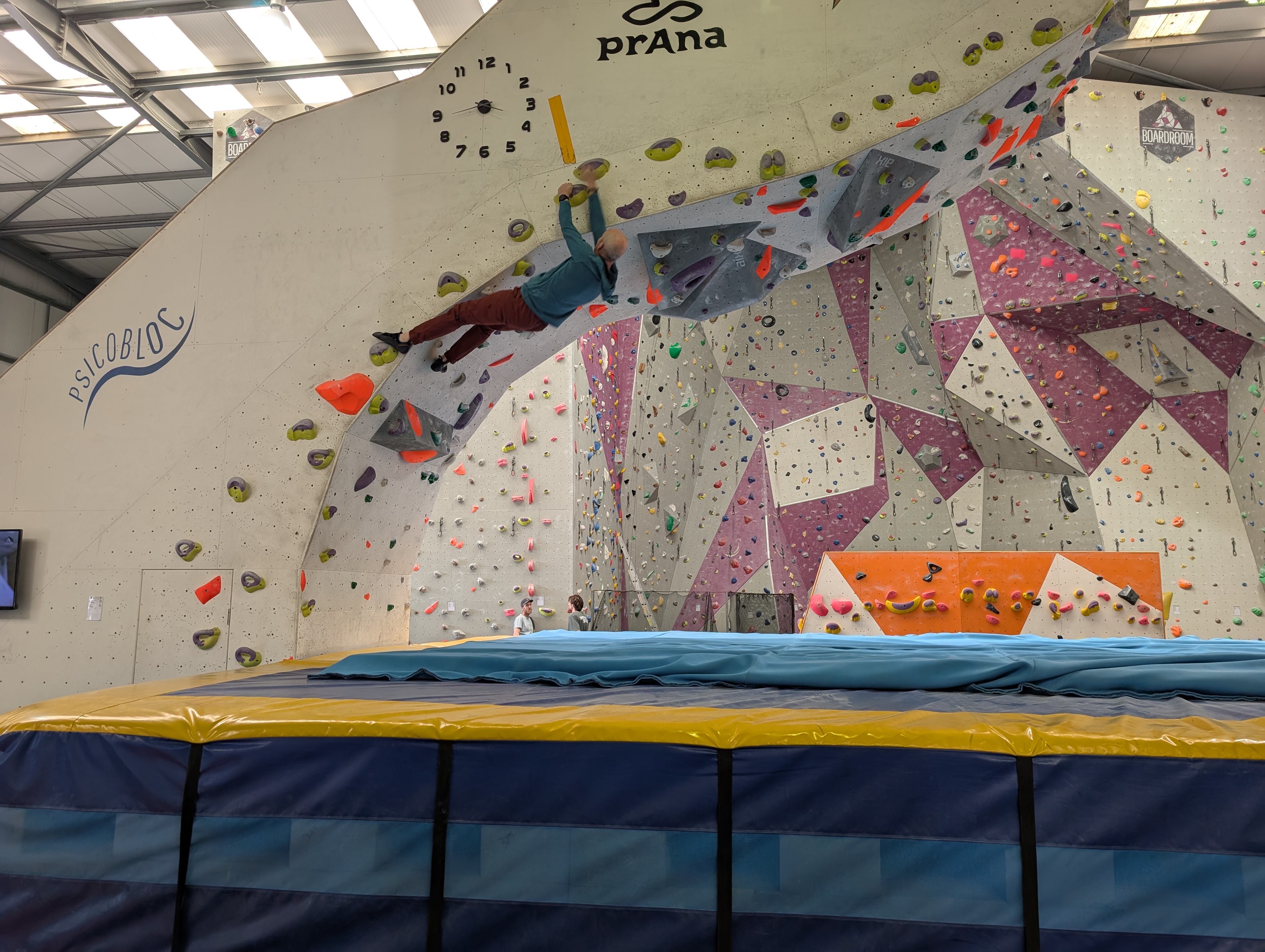
The Boardroom has the UK’s first Psicobloc, which after everything above about beating a fear of heights, still got me. It’s a solo climbing wall, no rope at all, eight metres up with thirteen metre lines, thick matting below to catch you if you come off. The club runs a completely separate induction and waiver just for it, which tells you most of what you need to know before you’ve even touched the wall.
I got about halfway up it and decided that was it, I wasn’t going any higher. Rather than downclimb, I let go, a deliberate fall into the matting, which felt completely counterintuitive the first time. You’re supposed to fall onto your back, not your feet, the exact opposite of every instinct you’ve got about landing on something. No rope to blame, nothing to hide behind, just me, the holds and a long way to think about it before I let go. It’s genuinely harder than it looks from the cafe below, and after Crib Goch I didn’t think there was much left that could catch me out like that. The Psicobloc found the gap. I’ll go back for it. Not yet.

The atmosphere is the actual story
We’ve climbed at centres in Caernarfon, London and Liverpool, and every one of them has been friendly. The Boardroom is something else again. It starts with the greeting from the team, and it carries through into the culture on the floor, people constantly chatting about beta, which is climbing shorthand for the specific sequence of hand and foot placements that make a particular problem work, or venting frustration after a failed attempt, or just asking for help. People are always up for a conversation and always willing to offer advice. I don’t know many sports where a fifty-five-year-old can genuinely and normally ask a thirteen-year-old for tips. We chat to people in their seventies right through every age group down to teenagers, and the teenagers are frequently the best climbers in the building, possibly because they haven’t yet discovered fear in the way the rest of us have. I can’t tell you if that’s a properly established idea or just something climbers say to each other, but it’s certainly what it looks like from the mats.
Chasing the same feeling elsewhere
I hope Tuesday at the Boardroom climbing wall stays a fixture for years to come. It’s also given Mark and me a good reason to visit other walls when we get the chance, to build experience, meet more people and see new places. Castle Climbing Centre in London and Beacon Climbing Centre in Caernarfon have both been very cool and genuinely welcoming. On the list for whenever we get the chance are the Edinburgh International Climbing Arena, the Big Depot in Manchester, and 270 Climbing. We’ll get to them as soon as we can.
What it actually costs
Since I get asked. A Family Taster session is £15 for an hour if you just want to try it as a group, no experience needed, full instructor support the whole time. On a normal visit, kids aged 4 to 6 are £7, ages 7 to 17 are £12.50, and an adult day pass is £16. If it sticks, the monthly direct debit membership is £59.99 for an adult, which is what I actually pay now, and it works out properly worth it once you’re going weekly rather than paying for single sessions. If you don’t own kit yet, hire on site is £4 for shoes, £4 for a harness, or £7 for both together. It’s also picked up a proper gym area recently, campus board, fingerboards, gym rings and general kit, if you want to train rather than just climb.
What I actually climb in
For shoes I wear the La Sportiva Finale. They’re pitched at intermediate climbers, which is honestly where I sit, and the thing that’s kept me in them is comfort. I can wear them for hours at a stretch without needing to peel them off between climbs, which some more aggressive performance shoes don’t let you do, while still being grippy enough on technical footwork to give me real confidence on smaller holds.
For a harness I use the Black Diamond Momentum 4S in Anthracite. My weight has fluctuated by around seven kilos over the time I’ve owned it, and it’s still comfortable at either end of that, which matters more than it sounds like it should when you’re wearing something for hours every Tuesday.
We’re going back to Nant Bychan again in a couple of weeks, sailing, walking and, weather allowing, no excuse to go anywhere near an indoor wall. Funny how a rainy day you didn’t want, two summers ago now, turned into the thing I look forward to every Tuesday. If you want the fuller story of the campsite itself, I wrote it up properly in my Nant Bychan Farm campsite review.
About the author
I’m Pete Harrison. I’m 55, I run a business, and I have a mild case of insomnia that means I spend a lot of time at 3am reading about gadgets, gear and ways to make life work better. Things I Learnt at 3am is where I write honestly about the things I’ve actually bought, tested and lived with. No fluff, no rehashing the spec sheet. Just the real verdict from someone who uses this stuff every day.
Leave a Reply