Tag: over 50

  • The Highest Number on My Allergy Test Was the Wrong Answer

    The Highest Number on My Allergy Test Was the Wrong Answer

    I paid for this test myself at full price. There is no affiliate arrangement with the laboratory and they have no idea I have written this. The one affiliate link in this post is to the antihistamine I actually take, marked where it appears. If you buy through it I may earn a small commission at no extra cost to you.

    It is 3am in April and I am awake because I cannot breathe through my nose. This happens every spring. I have always filed it under hay fever, taken the tablet, and got on with it.

    What I did not know, until this summer, is that the thing keeping me awake in April is ash pollen. Not grass. Not tree pollen in some vague general sense. Ash, specifically, which is the one tree I had never once considered.

    I found that out from a home allergy test UK labs will sell to anyone with a credit card, and the interesting part is not the result. It is that working out which test to buy took about six weeks, and taking it took about two minutes. Most of the consumer allergy market is selling something that does not work. Separating that from the thing that does was the actual job.

    Home allergy test UK kit box from Forensic Genomics Innovation Hub, teal packaging for the Allergy Solution ALEX3 test

    Why bother at all

    I take Allevia every day from roughly March to August. Fexofenadine, one tablet, and it is the difference between a functioning spring and a miserable one. I have taken it for years without ever knowing what I was taking it for.

    That is a slightly odd position to be in when you think about it. I am managing a response without knowing the trigger. If you know the trigger you can sometimes avoid it, sometimes treat it properly, and occasionally get rid of it altogether. If you do not, you take the tablet forever.

    That reframes allergy testing from a wellness indulgence into an actual question with an actual payoff. Allevia makes life bearable. Knowing why I need it might eventually mean needing less of it.

    It took me a long time to get to Allevia, and this is the part I would most like someone to have told me twenty years ago. For years I worked along the supermarket shelf. Every own brand box, every cheap pack of cetirizine and loratadine, one after another, season after season. They took the edge off. That was about all they did. I assumed hay fever was simply something you endured at a certain level and that I had found my level.

    Then a doctor prescribed fexofenadine, which is the drug in Allevia. A different tablet doing the same job in the same place, and for me a completely different outcome. Bazinga. For the first time the symptoms actually came down rather than being slightly muffled. I had spent the best part of two decades assuming hay fever was the problem, when a good part of the problem was that I had never happened to try the right tablet.

    And here is the bit I would rather not write down. On the really bad days one tablet does not hold it, and I take a second. That is more than the box says and more than I have been told to take, and I do it anyway, because the alternative is writing off a day to being thoroughly miserable. I am not recommending that and I would rather you did not copy me. What I should have done years ago, and what I am finally doing now, is treat it as information rather than a workaround. Needing to double up means the thing is not properly controlled, and there are real answers to that which are better than quietly taking two. Some of them are a different dose, some are a completely different type of treatment aimed at the part of the problem an antihistamine was never going to touch. All of them start with telling a GP the truth about what you are actually taking.

    There was also a funding route. My Medicash health cash plan has an Alternative Therapies allowance of about £250 a year, which I have never touched. Worth noting what else sits in that category: reflexology, reiki, homeopathy, hypnotherapy. Allergy testing is the only thing on that list with a real evidence base behind it, and it is filed alongside the rest of them.

    So is Allevia actually better, or just better suited to me

    I went and looked this up properly, because I had been telling people fexofenadine was better and I wanted to know whether that was true or whether I had simply got lucky.

    The short version is that it is not better. It is better suited. Those are not the same thing, and the difference might save you the twenty years I spent on the wrong shelf.

    What these tablets actually do

    When your immune system meets something it has decided is a threat, it releases histamine. The histamine then docks with receptors around the body, and the ones behind the sneezing, the streaming and the itching are called H1 receptors.

    An antihistamine does not remove the histamine. It parks in the space so the histamine cannot. That is the whole trick, and every tablet on that shelf is doing the same job in the same place. Which raises the reasonable question of why there are so many of them.

    The first generation, and why they knock you out

    The originals, chlorphenamine and diphenhydramine among them, work perfectly well. The problem is that they are small and fat soluble, so they do not stay where they are wanted. They cross into the brain, where H1 receptors are busy doing something else entirely involving staying awake, and they block those too.

    That is the drowsiness. It is not a side effect in the sense of something unexpected going wrong. It is the same drug doing the same job in the wrong building. It is also why these turn up in night time cold remedies, where being knocked out is the selling point rather than the complaint.

    The second generation, and the one that had to be withdrawn

    So the next lot were built to stay out of the brain. Loratadine and cetirizine are the two you will recognise from the supermarket shelf, and they are what I spent years working through.

    There was a third, and its story is the reason I now take what I take. Terfenadine, sold here as Triludan, was enormous through the 1980s and early 1990s. Then it emerged that as well as blocking histamine receptors it also blocked a potassium channel in the heart, which can stretch out the electrical cycle of a heartbeat and, rarely, tip it into a dangerous rhythm. It was worse if you were also on certain antibiotics or antifungals, or if you drank grapefruit juice, because those slow down the liver enzyme that clears it. It was withdrawn in the late 1990s.

    Here is the part I find genuinely satisfying. Your liver was never really using terfenadine anyway. It converted it, almost immediately, into a different compound, and that compound was doing the actual antihistamine work. It does not touch the potassium channel at all. The danger was in the version you swallowed, not the version your body made out of it.

    So they stopped selling the risky parent drug and started selling the safe end product directly. That end product is fexofenadine. The tablet I take every morning is the useful half of a drug that had to be pulled off the market, and it exists because somebody worked out exactly which part was doing the good and which part was doing the harm.

    The honest comparison

    Now the bit I was not especially hoping to find. On effectiveness, the evidence does not support fexofenadine being better. Head to head, standard doses of fexofenadine, cetirizine and loratadine come out roughly level for hay fever symptoms, and no second generation antihistamine has been shown to be conclusively better than the rest. If anything cetirizine edges ahead of loratadine in some studies.

    Where fexofenadine genuinely does differ is drowsiness. Cetirizine can be measurably sedating at a normal dose, which surprises people who assume everything modern is equally clear headed. Loratadine tends to be fine at a normal dose and less fine above it. Fexofenadine has been found free of sedative effects even above the recommended dose, because it is the one that stays most stubbornly out of the brain.

    For someone who drives a van, sails a boat and climbs on a Tuesday evening, that is not a small thing. But it is a different claim from being more effective, and I had been quietly making the wrong one.

    So what actually happened to me

    People do respond differently to different antihistamines, and that is well recognised rather than something I have invented to explain myself. Finding the one that suits you is a real thing, not a placebo story.

    But I have to be straight about the rest. I have one person’s experience, no control, no blinding, and no record of what the pollen was actually doing in the years I am comparing. A doctor handing you a tablet also carries a weight that picking a box off a shelf in a supermarket does not, and that on its own can change how well something seems to work. I cannot separate those out and I am not going to pretend I can.

    What I would say to anyone still working along that shelf is this. If the tablet you are on is not holding, the answer is not to endure it and it is not to take two. There is more than one of these, they are not interchangeable for everybody, and trying a different one is a five minute conversation with a pharmacist. I wish somebody had told me that at thirty five.

    The part that took six weeks

    If you search for an allergy test you will mostly be sold an IgG food sensitivity test. Two hundred foods, a colourful report, a list of things to eliminate.

    These do not work. Not in the sense of being a bit unreliable. In the sense of measuring the wrong thing entirely.

    IgG antibodies to a food are a normal marker of having eaten that food. The British Dietetic Association puts it plainly: a high IgG level to a food is more likely to mean you eat it regularly than that you are intolerant to it. Their position is that there is no convincing evidence for the test and it should not be used diagnostically. The NHS, BSACI and their European and North American equivalents all say the same thing.

    So a test that comes back saying you are sensitive to wheat, dairy and eggs may be telling you nothing more than that you eat toast.

    What you actually want is one of two things. A specific IgE blood test, or a skin prick test at a clinic. Both are clinically validated. Everything else is decoration.

    Why I did not do the skin prick test

    Nothing wrong with it. It failed on logistics.

    Skin prick testing needs you off antihistamines for three to seven days beforehand or you get false negatives. Coming off Allevia in the middle of the season, in a part of the country that is essentially one long hedgerow, is not something I fancied.

    I did work out a way round it. We spend two weeks every summer at a caravan on Anglesey and my symptoms reliably vanish there. That is a free washout window. Stop the tablet at the coast where you do not need it anyway, then test when you get back.

    Quite pleased with that, and then it turned out to be unnecessary. IgE blood tests need no washout at all. You keep taking your tablets and it makes no difference to the result. The entire problem I had just solved did not exist.

    The bit where I was confidently wrong

    This is the part I nearly left out, which is usually a sign it should go in.

    I read the Medicash terms properly. Section 10.8 requires payment to a qualified and insured practitioner, and receipts have to show that practitioner’s name, address and qualifications. A home kit you use at your kitchen table has no practitioner. The neighbouring benefit categories explicitly exclude home testing kits and lab tests not referred by a GP or consultant.

    Clear enough. Home kits are not claimable. That ruled out every postal test on the market and left me looking at private clinics.

    Then I emailed them and asked. Home testing kits are claimable under Alternative Therapies.

    I had built a careful, well-evidenced, entirely wrong conclusion out of a document. The wording genuinely supported my reading. The organisation that wrote it simply does not apply it that way. It cost me about a fortnight of going down the wrong road.

    The lesson is not complicated and I keep having to relearn it. When a few hundred pounds is at stake and an email costs you nothing, ask the people who administer the thing rather than reasoning from their paperwork.

    What I chose and why

    I ended up with the ALEX3 panel from the Forensic Genomics Innovation Hub, an ISO 17025 accredited lab at Southampton Science Park. £295, against my £250 allowance. £45 out of pocket.

    Three hundred parameters in a single finger prick. What matters is not the number, it is that 218 of them are molecular allergens rather than whole extracts.

    A whole extract test tells you that you react to olive. A molecular test tells you which specific protein inside the olive you react to. That sounds like a technicality. It is not, and I will come back to it, because it turned out to be the single most important thing about the entire result.

    One thing that made me trust them more, oddly. Their own FAQ says that an IgE response does not necessarily mean allergic disease, and that whether it is a true allergy remains a clinical diagnosis. A company actively talking down what its own product can tell you is a good sign. It is the opposite of how the IgG end of this market reads.

    Contents of the ALEX3 home allergy test kit laid out: box, lancets, alcohol wipes, blood tube, request form and instructions

    In which I discover I am not as tough as I thought

    The kit arrives with two lancets, two alcohol wipes, a small blood tube, a stand for it, plasters and a prepaid box. It could not be more straightforward.

    I sat in my office with the little clicky needle against my finger and could not push it.

    Not would not. Could not. Something in my brain is hardwired to stop me deliberately hurting myself and it turns out that wiring is stronger than my opinion of myself. I kept trying. I kept stopping. At some point I started giggling, alone, at my desk, at a piece of blue plastic.

    Eventually I built up to it and pushed. Nothing happened. Pushed harder. Nothing. So I gave it a proper shove and it went click, and it was a tiny scratch, and it did not hurt at all.

    Then it took ten minutes of squeezing to fill the tube to the line. That is the bit nobody mentions. The needle is nothing. The ten minutes of milking your own finger into a plastic vial is a different proposition, and if you are squeamish about blood you should get someone else to do it or use a nurse.

    Blood sample tube with yellow cap in its stand, filled to the line for the home allergy test

    Posted it on the Monday. Results in my inbox on the Tuesday. Medicash paid out within four days. I have had slower responses from people I live with.

    The results

    Total IgE came back at 182 against an adult reference of under 100. Roughly double. The report’s own summary is that allergy is likely.

    Of 300 parameters, 14 were positive. Four of them were high enough to matter.

    AllergenSourceLevel
    Ole e 1Olive pollen9.29
    Fra e 1Ash pollen8.21
    Art v 1Mugwort pollen5.19
    Alt a 1Alternaria, an outdoor mould4.23
    Phl p 5Timothy grass3.24
    Api g 7Celery3.01
    Phl p 1Timothy grass1.67

    Below those sat ragweed, rye, maize, Bermuda grass, Bahia grass and cat, all low.

    The top result is not real

    My highest number is olive pollen.

    I live in Buckley, in North Wales. There are no olive groves in Flintshire. There are no olive groves within several hundred miles of Flintshire. Whatever is making me sneeze in April, it is not an olive tree.

    Olive and ash are closely related, and the specific proteins measured here, Ole e 1 and Fra e 1, cross-react heavily with each other. My immune system cannot really tell them apart. So the olive result is a reflection of the ash result. Ash is the real one, and ash is a tree that grows in enormous quantities all over this part of the country.

    This is the entire argument for paying more for a molecular test. A cheaper whole extract panel would have handed me a high olive number with no way to tell it was a mirror. If I ever pursue immunotherapy, which is a multi-year commitment, being pointed at the wrong tree would be an expensive mistake in both time and money.

    The same logic sorts out the grass. I have positives for timothy, Bermuda, Bahia and maize, which looks like four separate grass allergies and is not. Two different timothy proteins came back positive, which the report treats as the marker of genuine grass sensitisation, and the rest are shadows cast by it.

    A long list of positives is usually not a long list of problems. It is a short list of real ones, repeated.

    The calendar matches almost exactly

    Here is where it stopped being a list of numbers and started being useful.

    Ash pollinates from late March into May. Grass takes over June and July. Alternaria spores peak from July through autumn. Mugwort runs August into September.

    You can check what the air is actually doing where you are. The Patient.info pollen map grades current levels region by region, low through to very high, and it updates through the season. What it will not tell you is which pollen. A high day in April and a high day in June look identical on the map and are two completely different problems for me, and until this year I had no way of knowing which one I was looking at.

    My symptoms run March to August. The biochemistry predicts late March to October. That is a good enough match that I sat looking at it for a while.

    The March start is the tell. Birch, alder and hazel are the usual early spring suspects and all three came back negative for me. A March onset with no birch sensitisation points straight at ash, which is exactly what the numbers say.

    The thing I was not looking for

    I ordered this test about hay fever. The result that actually matters is the mould.

    Alternaria is an outdoor mould. Damp vegetation, leaf litter, grass cuttings, compost, long wet grass. It is the mould most consistently linked with severe asthma flare-ups, and with thunderstorm asthma, where storms burst the spores into fragments small enough to get deep into your lungs.

    I get asthma symptoms during hay fever season. I have always treated that as part of the hay fever. And I spend an enormous amount of time on exactly the ground where this stuff lives, since between the dogs, the walking, three or four runs a week and the van we are outdoors on wet grass constantly.

    Seasonal sneezing plus seasonal wheezing is one airway, not two separate annoyances. An antihistamine does nothing for the lower half of it. That went on the list for a proper GP conversation rather than being folded into hay fever and ignored for another decade.

    The negatives were worth the money too

    House dust mite, all seven species tested, negative. Every dog protein on the panel, negative. Cujo and Blaze are entirely in the clear, which I was quietly worried about.

    All nuts, peanut, sesame, milk, egg, nineteen species of fish and shellfish, wheat and every grain, latex, venoms. All negative. No red meat allergy. No birch protein, which means no broad pollen and food crossover.

    On a three hundred allergen panel, exactly one food came up.

    Why the caravan works

    Two weeks every summer at a caravan on the Anglesey coast, and my symptoms reliably go away. Every year. I had never had an explanation for it beyond sea air being nice.

    The test explains it. Onshore winds off the Irish Sea carry air with far lower pollen and spore loads than anything inland. And because I have zero dust mite sensitisation, a caravan does not punish me the way it would someone whose problem is indoors. If mites were my issue, an enclosed damp textile-filled box would be the worst place I could take myself.

    I am also outdoors more in Anglesey, not less. So it is not that I am hiding from the air. It is different air.

    The lab result and a thing I noticed on holiday arrive at the same answer from opposite directions. Neither would have convinced me alone.

    Where I think this test is oversold

    Two honest problems, and I would rather raise them than let you find them.

    The first is the celery result. Api g 7 at 3.01 is a real number, it is tied to my mugwort sensitisation, and unlike some food reactions it does not break down with cooking. The report’s stated reaction range for it runs from a tingly mouth all the way to anaphylaxis, with talk of avoidance and adrenaline pens.

    I have never once reacted to celery. Not in fifty five years.

    Sensitisation is not allergy. Plenty of people carry this antibody and eat celery happily forever. Acting on that number would mean cutting out stock cubes, soups, stuffing and half the spice blends in the cupboard on the strength of a lab value and nothing else. I have noted it and moved on, and I will revisit it the day my mouth tingles and not before.

    Which leads to the second problem. Testing three hundred things when you have symptoms for four of them is exactly the practice allergy specialists warn about. Panel testing produces false positives, and false positives produce unnecessary restriction and unnecessary anxiety. My celery result is a live example sitting in my own report.

    If you go into this expecting a tidy list of things to avoid, you will come out worse off than when you went in. It gives you a pile of raw material, some of which is noise.

    The one thing it could not explain

    The only food I have ever noticed reacting to is Marmite.

    Three hundred allergens and it is not on there. Marmite is yeast extract, and the yeast species involved is not part of the panel. The only yeast tested is a skin one, and it came back negative.

    Given how clean the rest of the food section is, a classic allergy seems unlikely. Yeast extract is also one of the highest tyramine foods there is, very high in free glutamate, and carries a serious amount of salt, any of which can cause flushing and a stuffy head without involving allergy at all.

    So I do not know. A test that answered questions I had been carrying for a decade cannot tell me about the one food I actually noticed. I quite like that as an ending. It keeps the thing honest.

    The bit that matters most

    The report itself has no idea what is wrong with me.

    The interpretation software recorded no symptoms in every single category, because nobody asked me for any. So every page reads some version of sensitisation detected, symptoms not recorded. The lab measured antibodies. It could not measure allergy.

    Everything useful in this post came from putting the numbers next to things the lab never saw. A symptom calendar going back years. The fact that I live in North Wales and not the Mediterranean. Two weeks a year at a caravan. Nine years of sleep and respiration data from a watch.

    That is the same lesson I keep running into whenever I put my own health data together in one place. A single measurement is nearly useless on its own. It becomes worth something when you have three things pointing at the same answer.

    A £295 test measuring three hundred parameters was necessary and nowhere near sufficient. It did not produce an answer. It produced the raw material for one.

    Would I do it again

    Yes, and I would do it in exactly this order. Work out which test is real first, which is where nearly all the effort goes. Then take it. Then, crucially, sit down with the result and everything you already know about yourself, because the result on its own is just a column of numbers.

    What changed for me. I know my season now, and roughly which allergen owns which month. I know the caravan works and why. I know the dogs are innocent. I know the wheezing is its own thing and needs treating as such, which is the single most useful sentence in this entire post. And immunotherapy, which trains your immune system to tolerate a specific allergen, has gone from something I had never considered to something worth asking about.

    One practical footnote for anyone else managing blood pressure. A lot of over the counter hay fever combination products contain decongestants that push blood pressure up, so they are not for me. Plain non-sedating antihistamines and steroid nasal sprays do not have that effect. Worth checking the box rather than assuming, and worth asking a pharmacist if you are on anything for the same reason I am.

    None of this is medical advice. I am a bloke who bought a test and read the results carefully. Take any report like this to your GP or an allergist before changing anything, and particularly before changing medication.


    I’m Pete Harrison. I’m 55, I run a business, and I have a mild case of insomnia that means I spend a lot of time at 3am reading about gadgets, gear and ways to make life work better. Things I Learnt at 3am is where I write honestly about the things I’ve actually bought, tested and lived with. No fluff, no rehashing the spec sheet. Just the real verdict from someone who uses this stuff every day.

  • I Took Beetroot Shots for 33 Days. My Blood Pressure Did Not Move.

    I Took Beetroot Shots for 33 Days. My Blood Pressure Did Not Move.

    This post contains affiliate links, marked where they appear. If you buy through one I may earn a small commission at no extra cost to you. Read on before you do, because I am about to spend fifteen hundred words telling you it did not work for me.

    It is 3am and I am looking at a spreadsheet that tells me I have spent about forty quid on beetroot and a month of pulling a face at seven in the morning, and got precisely nothing for it. Which is, annoyingly, exactly the outcome I said I would publish if it happened.

    So here it is. The beetroot juice blood pressure trial I pre-registered back in June is finished, and the answer is no.

    The result, before anything else

    My daytime resting blood pressure before the trial was 133/85. My daytime resting blood pressure during the trial was 133/85.

    Not close to it. Not within a point of it. The same number.

    PeriodSystolicDiastolicReadings
    June, before beetroot13385approx 400
    July, on beetroot13385559
    Difference00

    I said in the protocol, before I drank any of it, that I would call a 3 mmHg drop in systolic pressure a signal worth taking seriously. That number was not plucked out of the air. It is roughly the low end of what the published research on dietary nitrate reports, and I wanted to commit to a threshold before I had any data, so that I could not quietly move the goalposts later.

    I got zero. Not 2 mmHg that I could squint at and call promising. Zero.

    What I actually did

    One shot of Beet It Sport Nitrate 400 every morning, starting on 25 June and finishing on 27 July when the supply ran out. That is 33 days, not the 30 I pre-registered, because a box does not divide neatly into a calendar and I was not going to throw the last three away.

    I am flagging that deviation rather than rounding it down to 30 and hoping nobody checks. Three extra days in the same direction does not change the conclusion, but the entire point of writing the protocol down first was that I would have to own the bits that did not go to plan.

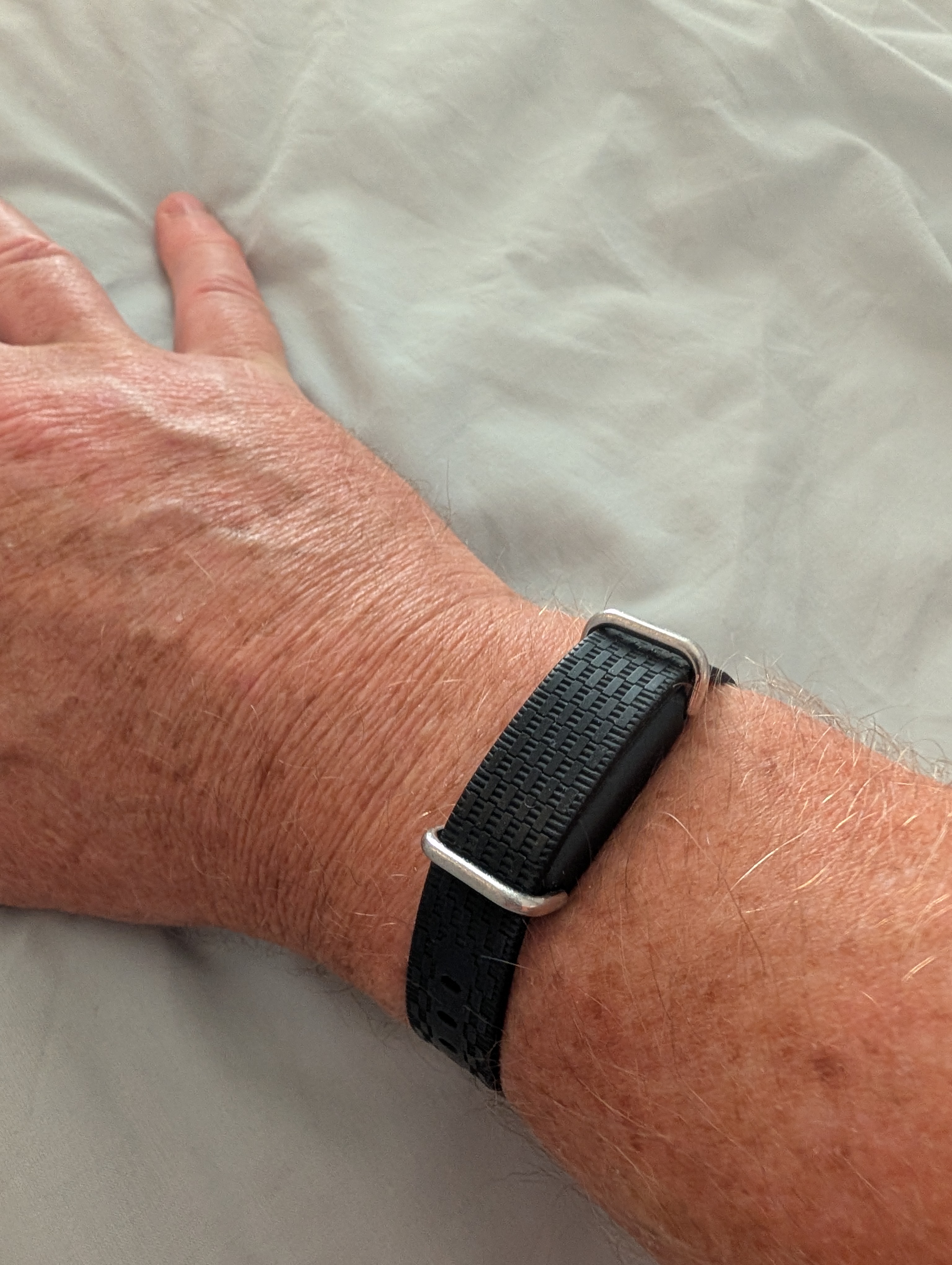
    Throughout, I wore the Hilo band continuously, as I have for two years. It takes readings on its own through the day and night without me doing anything, which is the whole reason this experiment was possible at all. A cuff would have given me one number a day taken at whatever moment I happened to remember. This gave me 824.

    I went looking for the effect anyway

    A single monthly average can hide things. An effect that built slowly, or faded, or only showed up in the first fortnight, would all average out to nothing. So I broke the whole month down week by week using every single reading, day and night, rather than the headline figure.

    WeekMean systolicReadings
    1 to 7 July128.1196
    8 to 14 July129.1218
    15 to 21 July128.6202
    22 to 27 July128.4208

    One millimetre of mercury of spread across four weeks, with no direction to it. The first ten days averaged 128.2 and the last ten days averaged 128.3.

    There is no effect hiding in there. There is no slow build. There is nothing to salvage.

    What this does not mean

    It does not mean beetroot does nothing for anyone. The research on dietary nitrate is real and I went through it properly in a separate reference piece before I started. What the studies mostly show is a modest effect, often larger in people who are not already medicated and not already being managed.

    I am neither of those. I have been on blood pressure medication since 2005 and I currently take lercanidipine and ramipril. It is entirely plausible that those are already doing the thing beetroot is supposed to do, and that there was simply no room left for it to work. That is a real explanation and I am not going to pretend it is not.

    It is also worth saying plainly what this study is. One person. No placebo. No blinding. No randomisation. I knew exactly what I was drinking and when, and I knew what I was hoping to see. Against that, the only real defences are that the measurement was automatic rather than something I chose to take when I felt like it, that the threshold was set in public before any data existed, and that there were 824 readings rather than a handful.

    The limitations I have to declare

    There was no upper arm cuff cross-check running alongside this. I disclosed that in the protocol and it stands as the biggest weakness. The Hilo calibrates monthly against a cuff, so it is not floating free, but I was not taking independent cuff readings in parallel to verify the trend.

    July was not a controlled month either. It was hot and we were away in the van twice. What it was not, and I checked this properly rather than guessing, is a month where my training fell apart. I ran 17 times during the dosing period, covering 134 kilometres in a little over 19 hours, which is three or four steady runs a week. That is about as consistent as I get. If anything the training got harder towards the end: my four fastest runs of the whole period all fall in the last ten days, averaging 7 minutes 53 per kilometre against 8 minutes 13 earlier in the month, and at a higher average heart rate to go with it. So the exercise side of my life was not quietly cancelling out a beetroot effect. It was, if anything, pointed the same way the beetroot was supposed to be, and the number still did not move.

    The last three days did run slightly higher, at 130.7 systolic against 128.6 for the month. I am not going to build a story out of that. It sits inside the normal daily spread, where individual days ranged from 124.3 to 132.6 throughout.

    On the affiliate link

    I have left the link to the product in this post, and I want to be straight about why.

    One person’s result is not evidence about yours, and the published research is genuinely more encouraging than my month was, particularly for people who are not medicated. If you have read all of that and want to try it, the link is there and it works.

    But I would rather you did not buy it because of me. I ran this properly and it did nothing, and quietly deleting the link so the failure looks tidier would be its own kind of dishonesty. So it stays, with the result attached to it.

    What happens next

    The protocol called for a 14 day washout after the last dose, which takes it to 10 August. I am still wearing the band, so that data is collecting itself whether I think about it or not.

    Honestly, I expect it to show nothing, because you cannot wash out an effect that never arrived. But I said I would publish it, so I will, and if it surprises me then that will be the more interesting post of the two.

    Was it worth doing

    Forty pounds and a month of mornings, for an answer of no.

    Yes, though. Before this I had a vague sense that beetroot was one of those things that probably helped a bit, picked up from headlines and supplement adverts at 3am. Now I know what it does for me specifically, which is nothing, and I can stop wondering about it and stop buying it.

    That is worth forty quid. The band that measured it cost rather more, and this is the clearest example I have had yet of why I wear it.

    None of this is medical advice. I am a bloke with a spreadsheet and a wrist band, not a doctor. Do not change any medication on the strength of a blog post. Talk to your GP.


    I’m Pete Harrison. I’m 55, I run a business, and I have a mild case of insomnia that means I spend a lot of time at 3am reading about gadgets, gear and ways to make life work better. Things I Learnt at 3am is where I write honestly about the things I’ve actually bought, tested and lived with. No fluff, no rehashing the spec sheet. Just the real verdict from someone who uses this stuff every day.

  • How Crawling Down Crib Goch Led Me to a Climbing Wall in Queensferry

    How Crawling Down Crib Goch Led Me to a Climbing Wall in Queensferry

    This post contains affiliate links, marked where they appear, to gear I’ve bought with my own money and use every week. If you buy through them I may earn a small commission at no extra cost to you.

    It’s 3am and I can’t sleep, running through a kit list for a caravan we’re not driving to for another couple of weeks yet. Climbing shoes. Harness. Chalk bag. We’re going back to Nant Bychan Farm on Anglesey, the site I only just wrote up properly, and a wet day there two summers ago is the entire reason any of that kit exists at all.

    A long way from comfortable with heights

    I used to have a genuinely debilitating fear of heights. I beat it over a period of years by doing the one thing that felt most stupid at the time, deliberately putting myself in front of every precipice I could find. My theory was simple. The moment something becomes routine and boring, you’ve overcome it. I don’t know if that’s an established idea with a proper name, exposure therapy in some informal, self-administered form perhaps, but it worked for me, slowly and without any drama.

    Two specific things still kept me wary of climbing itself, though, long after general heights stopped bothering me.

    The first was a climbing lesson on a sea cliff in Pembrokeshire. It felt properly unsafe, not because anything went wrong, but because the sea was directly below me the entire time and my brain never fully accepted that the rope was doing its job.

    The second was Crib Goch. If you don’t know it, Crib Goch is the narrow, knife-edge ridge that forms the first leg of the Snowdon Horseshoe in Eryri, technically a scramble rather than a climb, but with drops on both sides sharp enough that plenty of experienced hillwalkers give it a wide berth. My attempt went wrong before I even reached the ridge itself. I ended up lying on what felt like a near-vertical scree slope, so committed to staying attached to the hillside that I had my own head pressed into the scree for extra grip. My mate said come on. I said no, I’m not moving, call for a helicopter. The only thing that got me going again was him giving me a proper amount of verbal abuse, for which I remain genuinely grateful.

    Even getting up that slope was a saga. I crawled. On hands and knees, the whole way, until I could finally see the ridge itself and thought the worst was over. It wasn’t. The drop on the far side of the ridge was steeper than the one I’d just crawled up, which meant crawling the entire length of Crib Goch rather than just the approach to it. I still made it to the summit of Snowdon that day and refused to be beaten, but I came away thinking climbing, as a pursuit in itself, was frankly a bit stupid. Pointless risk for its own sake.

    A wet day at Nant Bychan changed the argument

    Two summers ago we were on our usual two-week static caravan holiday at Nant Bychan Farm on Anglesey when a rainy day forced a change of plan. Our daughters, fourteen and sixteen at the time, decided we were going indoor climbing, and I found myself in the position of having already emailed to book it before I’d properly agreed to the idea.

    We went to Indy Climbing Wall in Llanfairpwllgwyngyll. Our instructor was a man called Ryan Gibson, and his own story turned out to be a far bigger part of the day than I expected. As a teenager he spent years homeless around Holyhead, sofa-surfing and living rough, but kept turning up to school anyway because it meant a hot meal and a shower. A support worker connected to the Holyhead Opportunities Trust introduced him to climbing, and that led him to The Outdoor Partnership, a Welsh charity that helps people build careers in the outdoors. He was committed enough to walk from Holyhead to Bangor, more than once, just to get to training sessions. He’s now a qualified climbing instructor working at Indy Climbing Wall, and his story has been made into a short documentary that’s done the rounds at outdoor film festivals. It’s not the sort of thing you expect to hear on a rainy-day family activity booked out of parental obligation, and it changed how I felt about the morning before we’d even put a harness on.

    We climbed top rope, which for anyone who’s never done it means the rope is already anchored at the top of the climb and runs back down to you, with a belayer on the ground taking in slack as you go. You’re never more than a foot or so above your last point of protection, so a fall is a short, controlled drop rather than anything dramatic. It’s the gentlest possible introduction to being off the ground on a rope, and all four of us properly enjoyed it. It was genuinely family friendly, not just marketed that way.

    Home to Buckley, and the Boardroom climbing wall found me

    When we got home I looked up my nearest climbing wall out of curiosity more than intent. It turned out to be fifteen minutes away. The Boardroom in Queensferry, just up the road from Buckley. I haven’t looked back since.

    I did a top rope course first, so I could climb with a mate belaying rather than needing staff every visit. Then a bouldering course. Then an auto belay course, which is still, honestly, the bit that gets my heart rate up the most. An auto belay is a device fixed at the top of the climb with a retractable line attached to your harness, which controls your descent automatically the moment you let go or fall, so there’s no human belayer needed and you can climb entirely alone. Launching off the top of a route and trusting a mechanical device to catch you is a strange thing to do voluntarily the first few times. It’s also, statistically, very safe. Like a lot of climbing, the fear is mostly in your head rather than in any real risk.

    About a year in, climbing every Tuesday with the same mate I sail with, Mark, we took it up a level and did the lead climbing course. Lead climbing is different from top rope in one important way. Instead of the rope already being above you, you carry it up with you and clip it into protection points as you climb, which means for the first metre or two off the ground, before you’ve clipped in a couple of times, a fall genuinely can put you on the deck. Two things make this worse than it sounds like it should be. Dynamic climbing ropes are designed to stretch under load, which absorbs the shock of a fall but also adds real distance to how far you actually drop. And there’s always a small amount of slack built into the system between you and your last clip, enough that the rope doesn’t drag and get in your way as you move, but enough to add to a fall too. Put those together with the ground being close, and the first few clips are the genuinely risky part of a lead climb. The risk falls away fast once you’ve got height and gear between you and the floor.

    A Tuesday routine

    These days our Tuesdays follow the same shape most weeks. We’re there a good three hours most weeks, which sounds like a lot until you realise it’s also just how Mark and I actually see each other properly these days, better value than another walk, coffee or a pint would give us. We either lead climb or top rope first, then, after coffee that’s genuinely excellent and not just an afterthought, we go bouldering. Bouldering is shorter climbs done without ropes at all, at a height where the crash mats underneath are your entire safety system. It’s the most mentally demanding part of the session for me precisely because there’s no external safety net beyond a soft landing. If a hold near the top of a boulder problem feels sketchy, I’ll often just climb back down rather than commit to it, something I wouldn’t think twice about doing if I were roped up on the same move.

    The Psicobloc still has the better of me

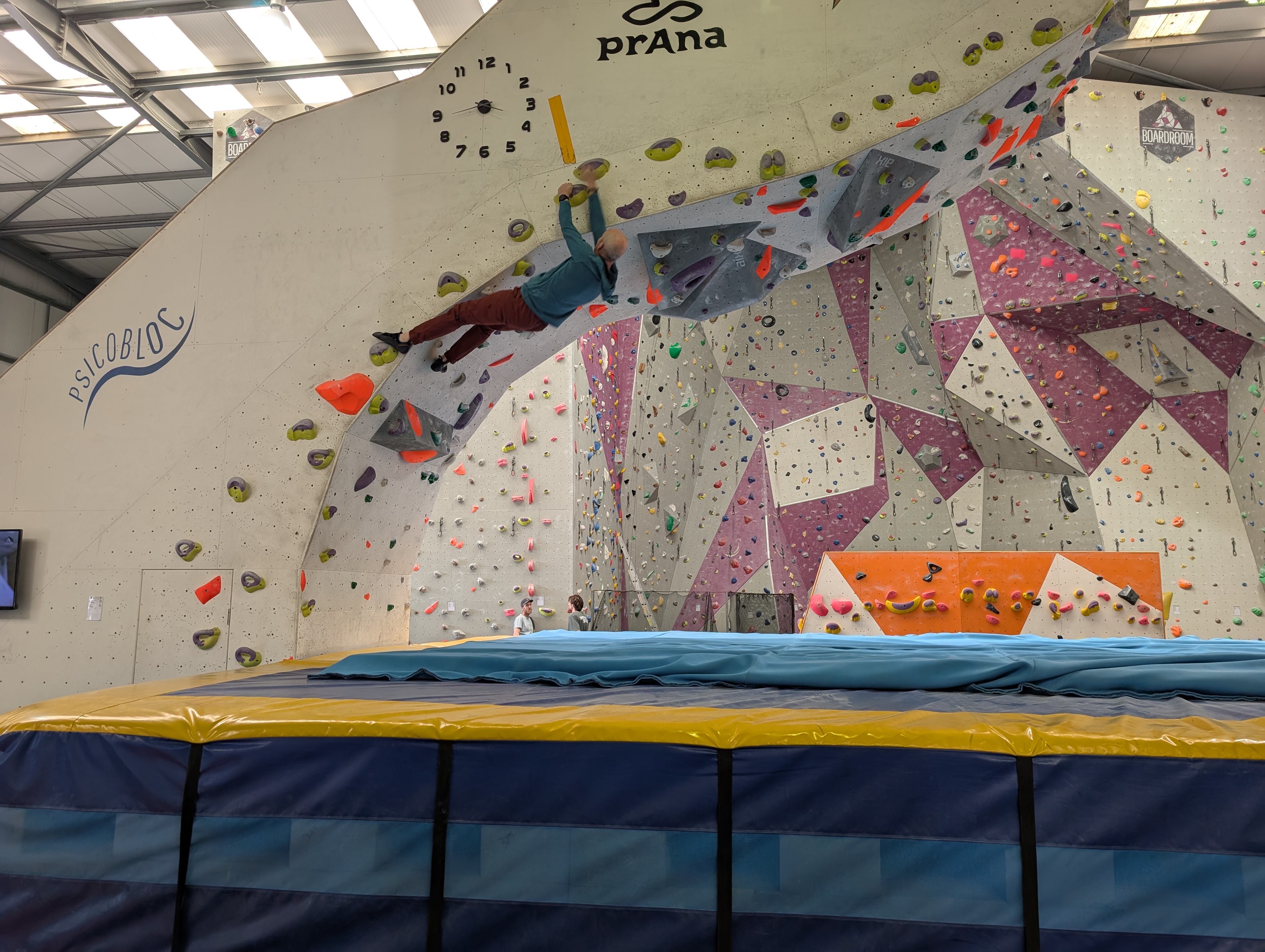
    The Boardroom has the UK’s first Psicobloc, which after everything above about beating a fear of heights, still got me. It’s a solo climbing wall, no rope at all, eight metres up with thirteen metre lines, thick matting below to catch you if you come off. The club runs a completely separate induction and waiver just for it, which tells you most of what you need to know before you’ve even touched the wall.

    I got about halfway up it and decided that was it, I wasn’t going any higher. Rather than downclimb, I let go, a deliberate fall into the matting, which felt completely counterintuitive the first time. You’re supposed to fall onto your back, not your feet, the exact opposite of every instinct you’ve got about landing on something. No rope to blame, nothing to hide behind, just me, the holds and a long way to think about it before I let go. It’s genuinely harder than it looks from the cafe below, and after Crib Goch I didn’t think there was much left that could catch me out like that. The Psicobloc found the gap. I’ll go back for it. Not yet.

    Pete on the Psicobloc wall at The Boardroom climbing wall in Queensferry, high above the crash mats with no rope

    The atmosphere is the actual story

    We’ve climbed at centres in Caernarfon, London and Liverpool, and every one of them has been friendly. The Boardroom is something else again. It starts with the greeting from the team, and it carries through into the culture on the floor, people constantly chatting about beta, which is climbing shorthand for the specific sequence of hand and foot placements that make a particular problem work, or venting frustration after a failed attempt, or just asking for help. People are always up for a conversation and always willing to offer advice. I don’t know many sports where a fifty-five-year-old can genuinely and normally ask a thirteen-year-old for tips. We chat to people in their seventies right through every age group down to teenagers, and the teenagers are frequently the best climbers in the building, possibly because they haven’t yet discovered fear in the way the rest of us have. I can’t tell you if that’s a properly established idea or just something climbers say to each other, but it’s certainly what it looks like from the mats.

    Chasing the same feeling elsewhere

    I hope Tuesday at the Boardroom climbing wall stays a fixture for years to come. It’s also given Mark and me a good reason to visit other walls when we get the chance, to build experience, meet more people and see new places. Castle Climbing Centre in London and Beacon Climbing Centre in Liverpool have both been very cool and genuinely welcoming. On the list for whenever we get the chance are the Edinburgh International Climbing Arena, the Big Depot in Manchester, and 270 Climbing. We’ll get to them as soon as we can.

    What it actually costs

    Since I get asked. A Family Taster session is £15 for an hour if you just want to try it as a group, no experience needed, full instructor support the whole time. On a normal visit, kids aged 4 to 6 are £7, ages 7 to 17 are £12.50, and an adult day pass is £16. If it sticks, the monthly direct debit membership is £59.99 for an adult, which is what I actually pay now, and it works out properly worth it once you’re going weekly rather than paying for single sessions. If you don’t own kit yet, hire on site is £4 for shoes, £4 for a harness, or £7 for both together. It’s also picked up a proper gym area recently, campus board, fingerboards, gym rings and general kit, if you want to train rather than just climb.

    What I actually climb in

    For shoes I wear the La Sportiva Finale. They’re pitched at intermediate climbers, which is honestly where I sit, and the thing that’s kept me in them is comfort. I can wear them for hours at a stretch without needing to peel them off between climbs, which some more aggressive performance shoes don’t let you do, while still being grippy enough on technical footwork to give me real confidence on smaller holds.

    For a harness I use the Black Diamond Momentum 4S in Anthracite. My weight has fluctuated by around seven kilos over the time I’ve owned it, and it’s still comfortable at either end of that, which matters more than it sounds like it should when you’re wearing something for hours every Tuesday.

    We’re going back to Nant Bychan again in a couple of weeks, sailing, walking and, weather allowing, no excuse to go anywhere near an indoor wall. Funny how a rainy day you didn’t want, two summers ago now, turned into the thing I look forward to every Tuesday. If you want the fuller story of the campsite itself, I wrote it up properly in my Nant Bychan Farm campsite review.


    About the author

    I’m Pete Harrison. I’m 55, I run a business, and I have a mild case of insomnia that means I spend a lot of time at 3am reading about gadgets, gear and ways to make life work better. Things I Learnt at 3am is where I write honestly about the things I’ve actually bought, tested and lived with. No fluff, no rehashing the spec sheet. Just the real verdict from someone who uses this stuff every day.

  • How We’re Going to Score Dog-Friendly Campsites From Now On

    It is 3am and I have four browser tabs open comparing how different websites decide what counts as a “dog-friendly” campsite. The honest answer, after an hour of digging, is that mostly they don’t decide anything. They just ask. So here is the dog-friendly campsite scoring system I built instead, one you can actually see the workings of.

    The problem with existing dog-friendly ratings

    There is a genuinely big player in this space already. DogFriendly.co.uk lists more than 50,000 dog-friendly businesses and sends scouts to research venues by phone questionnaire or in-person visit. They run a bi-monthly subscription magazine, a VIP membership with partner discounts, and an annual public-vote awards event. It is a proper, established operation. The Caravan and Motorhome Club has its own “Paws of Approval” rating too, one to five paws, voted on by members, but it only covers the Club’s own sites, not the hundreds of independent campsites like the one we stayed at this month.

    What none of them have is a rating you can actually see the workings of. DogFriendly’s scouts decide what they decide, and that decision does not come with a published checklist. You get a result, not a method. That is the gap I want to fill here, not by inventing a new industry, just by being transparent about the handful of things that actually matter when you turn up somewhere with two small dogs who think every campsite exists purely for their benefit.

    Our approach: tested, not phoned in

    Same rule as everything else on this blog. We only score campsites we have actually stayed at, with the dogs, in person. No phone questionnaires, no relying on what a website claims about itself, and nobody pays to be rated well. If a site is mediocre for dogs, the score says so.

    The dog-friendly campsite scoring system, version one

    This is a first version and it will get refined as we test it against more sites. Right now it covers eight things:

    A dedicated off-lead area or field. Not just “dogs allowed on site”, an actual space where they can run properly without a lead.

    A safe off-lead walk within easy reach. Somewhere away from busy roads that does not need a car journey to get to.

    Water access for cooling. A river, stream, or shallow water dogs can get into safely, which matters more every summer.

    Facilities practicality. Steps versus ramps, distance from pitch to facilities, whether a site actually works for anyone with a mobility issue, human or canine.

    Staff attitude to dogs. This one will not show up on any other rating system I have found, and it is one of the biggest differences between a site that tolerates dogs and one that actually welcomes them. You can tell within the first five minutes of a phone call.

    Pub or village walkability. Whether there is somewhere worth walking to with the dogs, and whether that place is actually happy to see them.

    Water bowls or dog-wash points. Small thing, genuinely useful, rare enough to be worth noting when it exists.

    Breed restrictions, disclosed upfront. If a site restricts certain breeds or numbers of dogs, that should be easy to find out before you book, not discovered on arrival.

    How this will show up on the blog

    Going forward, campsite reviews will carry a score against these eight points, written out plainly rather than hidden behind a single star rating, so you can see exactly why a site scored what it did and decide for yourself which of the eight actually matter to you. Our own Henstent Park review was written before this framework existed, but on rereading it against these eight points, it does well: proper dog walking field, riverside walks straight from the pitch, a ramp instead of steps, and a pub landlord who talks about dogs like he means it. Future reviews will have the scoring built in from the start.

    Since then it’s been used properly. Nant Bychan Farm on Anglesey scored honestly against it even though it isn’t a dedicated dog site, and the six North Wales sites roundup got a full retrospective score with the real gaps left as gaps. Every scored site lives on the Campsite Reviews hub.

    This is version one. It will change as we use it. If you have stayed somewhere brilliant or dreadful for dogs and think one of these eight points missed something important, I would genuinely like to hear it.


    About the author

    I’m Pete Harrison. I’m 55, I run a business, and I have a mild case of insomnia that means I spend a lot of time at 3am reading about gadgets, gear and, this time, why nobody has bothered publishing an honest dog-friendliness checklist. Things I Learnt at 3am is where I write honestly about the things I’ve actually bought, tested and lived with. No fluff, no rehashing the spec sheet. Just the real verdict from someone who uses this stuff every day.

  • Lake Vyrnwy: The Welsh Reservoir With a Drowned Village Underneath It

    Lake Vyrnwy: The Welsh Reservoir With a Drowned Village Underneath It

    No affiliate links in this one. Just a stop on the way home.

    It is 3am, a few nights after we got back, and I am reading about a Victorian water company that flooded an entire Welsh village on purpose. We had driven past Lake Vyrnwy a hundred times without really stopping to think about it. This time we stopped, and it turns out there is a lot more under that water than fish.

    Lake Vyrnwy straining tower reflected in the water, viewed through trees

    An easy detour on the way home from Henstent

    Lake Vyrnwy is only 20 minutes from Henstent Park, where we had just spent the weekend, so on the way home we parked up between the dam and Bethania watersports. Easy parking for a 6 metre van, no drama. From there it is a 10 minute walk up the lakeside to a little beach, where we sat with the dogs and did nothing much beyond admiring the view for a while. Then on to a tiny cafe near the Chocolate Cabin for a coffee before the drive home.

    Honest caveat: the drive from Henstent to Vyrnwy is genuinely scenic, but several miles of it are single-track lane, and it was not entirely stress-free even in the Giottivan. I would not want to do that particular stretch in a bigger van. Once at the lake itself, the road around it is normal width and the parking is straightforward.

    Walkers crossing the stone aqueduct bridge at Lake Vyrnwy dam

    The village Lake Vyrnwy drowned

    Lake Vyrnwy is not a natural lake. It is a Victorian reservoir, built in the 1880s by Liverpool Corporation to supply fresh drinking water to Liverpool and Merseyside. The dam was completed in 1888 and was the first large stone-built dam in the UK, and the first anywhere designed to let surplus water cascade straight over its face rather than through a side channel. It is still an impressive thing to stand next to.

    Stone dam wall at Lake Vyrnwy with the river below

    Building it meant flooding the head of the valley, and with it the original village of Llanwddyn. It was a proper village too, not a hamlet: two chapels, three inns, ten farmhouses, and 37 houses, plus a manor house called Eunant Hall that was demolished and never rebuilt. People carried on living in the old village right up until the work was finished. A new Llanwddyn, the name it still carries today, was built about two miles away on higher ground, complete with a new church that was consecrated the day before the valves closed and the valley began to fill. The population today is around 300.

    The old village never fully disappears, either. In genuine drought years the water level drops low enough that the foundations of the original buildings resurface, most recently getting attention during the 2022 heatwave. We were not lucky or unlucky enough to see any of that ourselves, the lake was full when we visited, but knowing it is down there changes how you look at the water.

    View of the Berwyn hills from the fields near Lake Vyrnwy

    The village today

    Modern Llanwddyn sits above the waterline with holiday statics and lodges scattered up the hillside, a proper little tourist economy built around the lake and the RSPB reserve it now supports. Cujo and Blaze found their own stretch of stream near the static caravans to cool off in, which by that point in the weekend had become the theme of the whole trip.

    Caravans and campervans on a field near Lake Vyrnwy with mountains behind

    Worth the stop

    We have driven past Lake Vyrnwy more times than I can count without really stopping. This time, twenty minutes and a short walk turned it from a nice view out of the window into somewhere with an actual story attached, and a slightly uncomfortable one at that: a whole community moved, more or less on Liverpool’s timetable, so a city could have water. Worth building into any trip through this part of Wales, whether you are coming from Henstent Park or exploring the wider area covered in our North Wales campervan sites roundup.


    About the author

    I’m Pete Harrison. I’m 55, I run a business, and I have a mild case of insomnia that means I spend a lot of time at 3am reading about gadgets, gear and, this time, Victorian reservoir engineering. Things I Learnt at 3am is where I write honestly about the things I’ve actually bought, tested and lived with. No fluff, no rehashing the spec sheet. Just the real verdict from someone who uses this stuff every day.

  • Henstent Park: The Most Dog-Friendly Campsite We’ve Found

    Henstent Park: The Most Dog-Friendly Campsite We’ve Found

    This post contains affiliate links, marked where they appear. If you buy through one I might earn a small commission, which costs you nothing and doesn’t change what I write.

    It is 3am and I am lying awake listening to ten blokes on motorbikes drink themselves louder by the hour, on a campsite near Lake Vyrnwy that had done nothing wrong except be next to that particular group on that particular night. I gave up trying to sleep and started googling nearby campsites instead. Henstent Park was top of the shortlist. I called the next morning, they were genuinely helpful, and they found me a spot. That bad night is the entire reason this site exists on this blog at all.

    Henstent Holiday Park sign at the entrance, stone wall, hills behind

    Where Henstent Park actually is

    Henstent Park sits in Llangynog, Powys, on the B4391, the Llanfyllin to Bala road, about 18 miles west of Oswestry. It is tucked into the Tanat Valley on the fringe of the Berwyn mountain range, right on the edge of Snowdonia National Park, with the river Tanat running along one boundary. The village of Llangynog is five minutes’ walk and has two pubs. There are several hiking trails straight from the site, including an 8 mile route to Pistyll Rhaeadr, the highest waterfall in Wales, and decent mountain biking locally if that is more your thing. Bala Lake and Lake Vyrnwy are both close enough for a half-day trip, which is exactly how our own visit ended.

    It is a family-run park, open 11 months of the year, with a mix of touring pitches and a good number of privately owned seasonal holiday homes dotted around. There is a separate camping dell for small tents right by the river. I first stayed solo with the dogs. This time I brought Suzy too, because I thought it would be right up her street, and I was right.

    The pitch: worth being specific about

    On the first visit I got a spot in the middle of the field, no complaints, completely surrounded by hills, quiet, with only a minor B road for access so road noise is minimal. This time, booking again, I was specific: I wanted a riverside grass pitch, not hard standing. The hard standing pitches are perfectly functional but they do not look as pretty and sit closer together. They gave me Pitch 1. It is right next to the river, close enough that the riverside dog walk path runs between the water and the van, and it backs onto an unoccupied seasonal caravan and the tent area. If you are booking and can ask for it by number, ask for Pitch 1.

    Worth knowing before you book: clicking “Book Now” on Henstent’s own website takes you through to Pitchup. Nothing wrong with that, it is a straightforward booking process, but it does not let you choose your actual pitch. You get allocated one. Pitch 1, the riverside one described above, is the desirable one, so if you want it specifically, call the site directly and ask rather than relying on the online booking to sort it for you.

    Giottiline Giottivan 60T parked on riverside pitch at Henstent Park with awning and windbreak up

    Facilities, and why they mattered more than usual

    The Giottivan has its own toilet and shower, but we always check a site’s facilities anyway. Henstent’s were genuinely good: clean, private, and noticeably cool inside despite the heatwave outside. There is also a ramp up to the block, which turned out to matter more than I expected. Suzy has rheumatoid arthritis, and it is hit and miss day to day. Some days she is doing the full dance routine to Steps, other days getting in and out of the van is a struggle. On a flare day, even with facilities on board, two steps up into the van is not always practical. A few extra metres of shuffling up a ramp beats that every time.

    Accessible toilet and shower block at Henstent Park with wheelchair ramp

    There is also a proper washing-up room, fridge, freezer, washing machine, dryer, and sink, exactly the kind of thing we would have loved in our old VW, especially in this heat. And tucked onto a shelf next to the fridge, a stash of books, DVDs, and some proper blast-from-the-past board games, Buckaroo and Headache among them, which had Suzy fully back in school-summer-holiday mode within about ten minutes.

    Book and board game shelf at Henstent Park including Buckaroo and Headache

    The hottest weekend of the year, and keeping the dogs cool

    We picked the hottest weekend of the year to visit, which the Giottivan handled well. Being able to open the rear doors right up helps a lot with airflow. Cujo and Blaze got their own cooling routine: sitting in the shallow river with them, and Cujo wearing an evaporative cooling jacket (size XXS on him), which genuinely worked well.

    Cujo the chihuahua wearing a cooling jacket standing in the river at Henstent Park

    I take this more seriously than I used to. Cujo has a heart condition, as regular readers know from an earlier post, and heat is not a small thing for a dog with a cardiac history. Heatstroke does not just make a dog uncomfortable, it causes direct thermal injury to the heart itself. Vets at Cornell, the American Kennel Club, and a UK-wide VetCompass study covering over 900,000 dogs all confirm the same thing: heat stress can damage the heart muscle and its electrical conduction, and up to a quarter of dogs with heatstroke develop an arrhythmia because of it. Some of that damage can be permanent, even in dogs that otherwise recover. Dogs cool themselves mainly by panting rather than sweating, which is a much less efficient system than ours, and dogs with existing cardiac conditions are specifically flagged by vets as needing extra caution in hot weather. None of that stopped us going, but it is why the river and the cooling jacket were not just nice-to-haves this trip. They were the plan.

    The walk to the village, a closed cake shed, and a good man called Dei

    It is a lovely walk along the river into Llangynog, the same route the dogs used to cool off along the way. The village has a genuinely charming honesty-box cake shed, the kind of thing that makes you want to move somewhere smaller. On the day we walked past, it was shut, with a handwritten chalkboard sign propped in the doorway: closed due to hot weather. Fair enough. Nobody wants to sell melted cake.

    Handwritten sign reading Closed due to Hot Weather on the honesty box cake shed in Llangynog

    We carried on to the New Inn, which was friendly and, by the look of the menu, does proper pub food, though we did not eat there this time. We got chatting to the owner, Dei, and I asked whether he had ever thought about adding a little shop onto the pub, the way the Eagles does at Llanuwchllyn on Bala Lake. He said a lady runs a lovely little shop two miles away and he would not do anything to jeopardise her business. That is a small thing to say to a stranger in the pub, and it told me more about the place than the menu did.

    Dinner back at the van: an Aldi steak and a bit of cheating

    Back at the pitch, a steak from Aldi, cooked on the Cadac Safari Chef 30 LP Deluxe Pro QR. If you go this route, the hose and regulator matter more than you would think: we run the JD Brands 37mbar propane regulator and the matching JD Brands LPG hose, connected to a red propane tank we carry in the van. I will admit to a bit of cheating: I used the Steakmate app to get the timing and temperature right rather than trusting my own judgement. It worked. Cooked to perfection, and I am not sorry.

    The kit that earned its place on this trip

    A few things on board finally got a proper first test in real conditions. The windbreak took about 20 minutes to put up, definitely a two-person job, but it held rock solid in a fairly breezy spell and gave us proper privacy without shutting off the view. Alongside it we used the same tie-downs on the Fiamma canopy awning, and they were genuinely strong and effective, no flapping, no worry about the wind getting under it.

    Berghaus Wind Stop windbreak set up at Henstent Park pitch

    On the table, the PORTAL folding camping table earned its keep for alfresco eating, height-adjustable legs, easy up and down, no fuss. And overnight, the Warmco D4 rechargeable fan ran all night on a single charge, quiet enough not to notice, powerful enough to matter. In a heatwave, that fan alone made the difference between a decent night and a rough one.

    PORTAL folding camping table close up showing branding and aluminium slats

    Dog-friendliness, scored

    This trip predates our eight-point dog-friendly scoring system, but scoring it retrospectively is straightforward, and honest scoring means saying where we simply don’t have the information rather than guessing:

    • Off-lead field: yes. A genuine dedicated dog walking field, not just “dogs allowed on site.”
    • Safe off-lead walk nearby: yes. The riverside path runs straight past the pitch.
    • Water access for cooling: yes. Shallow, safe river access right there, used daily.
    • Facilities practicality: yes. Ramp rather than steps into the block.
    • Staff attitude to dogs: good, based on a helpful phone booking and a warm welcome on arrival, though we don’t have a specific dog-related anecdote from Henstent’s own staff the way we do from the New Inn.
    • Pub or village walkability: yes. Llangynog and the New Inn are a five-minute walk.
    • Water bowls or dog-wash points: not confirmed. We didn’t specifically check for these, so we’re not claiming it either way. Worth checking next visit.
    • Breed restrictions disclosed: not checked this trip.

    Six of eight confirmed positive, two honestly marked as not checked. That’s a strong score, and a good first real-world test of whether the framework actually works. It does, at least well enough that we’ll be tightening the “staff attitude” and “dog-wash point” questions into the booking call itself next time, rather than leaving them to be noticed on arrival.

    The verdict

    Henstent Park is one of those campsites that came out of a genuinely bad night somewhere else, and turned out better than anywhere I had been looking for on purpose. Quiet, dog-friendly with a real dog walking field where they can properly run off lead, good facilities that happen to work for mobility issues as well as convenience, a village worth the walk, and a pub run by someone who turns down easy money to protect his neighbour’s business. We will be back, and next time I am asking for Pitch 1 again.


    About the author

    I’m Pete Harrison. I’m 55, I run a business, and I have a mild case of insomnia that means I spend a lot of time at 3am reading about gadgets, gear and, this time, ten blokes on motorbikes. Things I Learnt at 3am is where I write honestly about the things I’ve actually bought, tested and lived with. No fluff, no rehashing the spec sheet. Just the real verdict from someone who uses this stuff every day.

  • The Winter of Frankie Machine: The Book That Got Me Reading Again at 3am

    The Winter of Frankie Machine: The Book That Got Me Reading Again at 3am

    Bought with my own money. This post contains one affiliate link, to the Kindle edition on Amazon. If you buy through it I might earn a small commission, which costs you nothing and does not change what I write.

    The Winter of Frankie Machine by Don Winslow book cover

    It is 3am and for the first time in years the thing in my hand is not a phone. It is a Kindle, showing The Winter of Frankie Machine, and I can feel my heart rate coming down a notch with every page rather than climbing the way it does when I am doom-scrolling something I will not remember by breakfast. This is new territory for this blog. Welcome to the first entry in Book Reviews.

    How the phone won, and how it lost again

    I used to read properly, years ago. Then insomnia and a phone within arm’s reach did what they do to most people, and reading quietly turned into scrolling. I work on my own most days, so I get through a stack of audiobooks, van journeys, dog walks, jobs round the house. Audiobooks are great company. But they are not the same thing as reading, and I had half forgotten that until recently.

    The difference at 3am is bigger than I expected. A phone screen keeps my brain switched on exactly when I need it switched off. A book, or in this case a Kindle with nothing else running on it, does the opposite. No notifications, no next video queued up, nothing pulling me sideways. Just one story, at the pace I set. It is genuinely therapeutic in a way scrolling has never once managed, and getting back into the habit has felt like finding something I did not realise I had lost.

    The Winter of Frankie Machine, on the surface

    The book that pulled me back in was The Winter of Frankie Machine by Don Winslow, which I read on Kindle (same edition here). On the surface it is exactly what the cover promises. Frank Machianno is retired, running a bait shop on the San Diego waterfront, making sandwiches, minding his own business. He used to be a hitman for the mob, and naturally his past does not stay retired along with him. There is a manhunt, old scores, the whole mechanics of a proper crime thriller ticking along underneath.

    Read purely as a thriller it does the job. It moves. I read most of it across a run of nights rather than one sitting, which for a book like this is unusual for me, and it never lost its grip between one 3am and the next.

    What actually kept pulling me back in

    What I did not expect was how often the story circled back to something quieter than the plot. Frank is a hitman, a man who has done genuinely bad things for money, and yet the book keeps returning to a set of values that have nothing to do with violence at all. Have a kind heart. Work hard. Look after your family. Value your friends. Those threads run right through the book, underneath the guns and the double-crosses, and by the end they are doing more of the work than the plot mechanics are.

    It is an odd thing to take from a mafia novel, but it is honestly what stayed with me. Frank’s code is not a legal one and it is not a clean one, but it is a code, and there is something oddly grounding about watching a character hold to it even as everything around him falls apart. I finished the book thinking less about the shootouts and more about the fact that hard work and loyalty to the people you love are the same values whether you are running a legitimate business or, as it turns out, whether you used to run the other kind.

    Did it actually help me sleep

    Honest answer, not always, and I am not going to pretend a good thriller is the ideal choice for winding down when you genuinely want your heart rate to drop rather than to find out what happens next. There were nights I read on well past the point I meant to stop. But even on those nights it beat the phone by a mile. My eyes got tired the normal way instead of the blue-light way, and I was reading a real story rather than refreshing the same three apps out of habit. That is the actual win here, not perfect sleep hygiene, just a better way to spend the hours when sleep will not come.

    It has also given me something to compare against the sleep data my Garmin Fenix 8 already tracks every night, for whatever that ends up being worth once I have more than a few weeks of it.

    The verdict

    The Winter of Frankie Machine is a proper page-turner that somehow also has something to say about the values that hold a life together, family, work, loyalty, even when the life in question is a strange and violent one. I would recommend it on the plot alone. I would recommend it more for what it left me thinking about after I put it down. Either way, it did exactly what I wanted at 3am. It got a book back in my hand instead of a phone, and that is worth more to me than the ending.

    This is the first post in a new Book Reviews section. I have no idea yet whether it will end up mostly crime novels or go wherever the insomnia takes me. Given how this one started, I suspect it will be a mixed bag.


    About the author

    I’m Pete Harrison. I’m 55, I run a business, and I have a mild case of insomnia that means I spend a lot of time at 3am reading about gadgets, gear and, lately, actual books. Things I Learnt at 3am is where I write honestly about the things I’ve actually bought, tested and lived with. No fluff, no rehashing the spec sheet. Just the real verdict from someone who uses this stuff every day.

  • Ten Miles From Chester and We Still Don’t Go Enough: Revisiting a Riverside Walk We’d Let Slide

    This post contains one affiliate link, to my existing Hoka sandal review. Everything else here is unpaid. Nobody sponsored a walk along a river, and the only money that changed hands was £6.50 for a day’s parking.

    It was gone 3am on the Friday night and I was doing the thing I always do, lying awake with the phone too close to my face, drawing a wiggly line along the River Dee on Komoot instead of sleeping. We live ten miles from Chester. Suzy and I both grew up practically on its doorstep. And somehow we visit about as often as people who live next to a famous landmark actually go and look at it, which is to say almost never.

    The van makes it embarrassingly easy to fix that. Park up, walk in, no faff finding somewhere to leave the dogs. So on Saturday afternoon I did exactly that, parked at the Little Roodee, and went back to a Chester riverside walk we used to do all the time and had somehow let slide for years, instead of the city centre. Here’s the full route.

    Chester riverside walk route map showing Little Roodee car park along the River Dee through Queens Park and the Meadows to the turnaround point and back

    Full interactive route on Komoot, including elevation, timings and a downloadable GPX if you use the app.

    The Little Roodee: Chester’s Cheapest Overnight, Right Next to the Oldest Racecourse in the World

    The Little Roodee car park sits right next to Chester Racecourse, which everyone locally just calls the Roodee, and within sight of Chester Castle’s sandstone walls rising over the far side of the car park. I always assumed the racecourse was one of the oldest in Britain. It’s actually recognised by Guinness World Records as the oldest racecourse still in operation anywhere in the world, with racing on record here since 1539, though some accounts trace the very first meeting back to 1512. The name Roodee comes from Rood Eye, meaning the Island of the Cross, after a stone cross that stood on a silted-up island in the river back when the Romans were using this spot as a harbour.

    Little Roodee Car Park fees sign in Chester showing daily charges for cars, buses and coaches

    Cheshire West and Chester Council run the car park. Our size of van gets charged under the Buses, coaches and goods vehicles over 3.5 tonnes tariff, not the standard Cars rate: £7 for up to 3 hours, £9.50 for up to 6 hours, £11.50 for up to 12 hours, or £5.50 for arrivals after 6pm through to 10am the next day, which is the rate that makes an overnight stay here genuinely affordable. We’ve stayed under that overnight rate many times. There was also a variation notice taped up next to the main board, since the council had just put the prices up from 24 June 2026.

    Cheshire West and Chester Council notice of a 2026 price variation at Little Roodee car park

    Worth checking their current rates before you go, since councils update these things without much warning. What matters for us is that it’s a genuinely useful spot. It’s a 10 to 15 minute walk into the city centre, which makes it perfect for the evenings when Suzy and I fancy dinner in Chester with the dogs and a couple of drinks each, then a two minute stagger back to bed rather than a taxi home.

    Along the River, Walls on One Side, the Dee on the Other

    I hadn’t fancied the city centre that afternoon, but I did fancy a proper walk with the dogs, so I picked up the river path with the water on one side and Chester’s city walls running along the other. The walls are worth a mention on their own. They’re generally reckoned to be the oldest, longest and most complete set of city walls surviving anywhere in Britain, first built by the Romans getting on for two thousand years ago and added to steadily ever since. Walking alongside them at ground level, rather than up on the walkway that runs along the top through the city centre, gives you a completely different sense of scale.

    Tree-lined riverside path in Chester running alongside the sandstone city walls

    Queen’s Park Suspension Bridge (And Why It Looks Familiar)

    The path brought me out at the Groves, Chester’s riverside promenade, with Queen’s Park Suspension Bridge crossing the Dee just ahead. The current bridge dates from 1923, replacing an earlier chain bridge from 1852 that was built specifically to open up the new Queen’s Park suburb on the far bank. If it looks familiar and you can’t place why, it’s probably Hollyoaks. The bridge has turned up in the show’s opening titles across several different eras, most recently with a drone shot flying straight towards it, which is a very Chester way to become famous.

    Queen's Park Suspension Bridge crossing the River Dee in Chester, with the Groves promenade and Georgian buildings alongside

    Into the Meadows

    I crossed the bridge and kept the river on my left, following the path into what’s known as the Meadows, or more fully Chester’s Earl’s Eye Meadows. Once you’re through the last of the trees it opens right out into proper wide-open grassland, a real contrast after the enclosed riverside path.

    Open grassland at Chester's Earl's Eye Meadows with houses visible on the horizon

    There’s a good information board on site that fills in the history properly. The land was gifted to the council in 1929 by Harry and Phyllis Brown for all the people of Chester to enjoy for recreation. Phyllis Brown went on to become the city’s first female mayor. Two of the events still held on the river here are amongst the oldest of their kind in the country, the Chester Regatta, which dates back to 1733, and the Dee Mile swimming race. The name Earl’s Eye refers to an area surrounded by water that once belonged to the Earl of Chester, and drainage ditches had to be cut across the meadows in the 18th century just to let cattle graze on what was otherwise waterlogged ground. Kingfishers, kestrels and sedge warblers are all regularly spotted here, and the board mentions Friends of the Meadows, a local group set up in 1980 after resident Adele Edwards noticed the land was being neglected.

    Chester Earl's Eye Meadows information board showing the site map, wildlife and history

    Riverside Houses and the Deva Divas

    The path carries on alongside some genuinely lovely riverside houses, the kind you slow down and gawp at a bit. Cujo trotted this stretch like he owned it.

    Cujo the chihuahua walking along a gravel riverside path in Chester with large houses on the far bank

    Further along, a group of people were setting up gazebos and tables near the river, clearly getting ready for something the next day. I now know exactly what it was: the Deva Divas Triathlon, run by Chester Triathlon Club, held on the Meadows every year on the first Sunday of July. It’s a women-only short-distance event, and it’s the only race ever to win British Triathlon’s Event of the Year award twice, in 2009 and 2016. My first guess was the Chester Triathlon, which was wrong, since that ran a full month earlier on 7 June. Worth knowing if you’re planning a July weekend here with a van and want to either watch or avoid the crowds.

    Pleasure Cruises, a Sailing Club and a Free Ferry

    A bit further on one of the local pleasure cruisers, The Jackie, came past packed with passengers, followed shortly by Chester Sailing Club with a yard full of small dinghies under cover, then a proper ferry crossing point.

    The Jackie pleasure cruiser boat on the River Dee in Chester with riverside houses on the hillside behind
    Chester Sailing Club on the River Dee with small dinghies stored on the bank below houses on the hillside

    The ferry only runs weekends and bank holidays from Whit through to the last Sunday in September, sailing between 10:30am and 4:30pm on request. Adult and senior fares are £1 each way, children under 15 are 50p, and dogs and bicycles are also 50p each way. It’s a genuinely useful thing to know about if you’re on foot on one bank and want to reach Sandy Lane or the Meadows on the other without doubling back two miles to the nearest bridge crossing.

    Cheshire West and Chester Council Ferry Sailing Times sign on the River Dee at Sandy Lane

    Horses (Understandably Unnerved)

    I also passed a couple of horses grazing right across the path with the dogs on leads, and I’ll admit I gave them a wide berth. I was once chased off a farm by a genuinely angry horse years ago, and it’s the kind of thing that stays with you. Cujo and Blaze were more curious than bothered, but I wasn’t taking any chances.

    Two horses grazing directly across a footpath near Chester's Earl's Eye Meadows

    Turning Around Halfway Through the Chester Riverside Walk

    I reckoned we’d gone about two and a half miles by the time I turned around, and the GPX track backs that up almost exactly. The whole loop came out at just over five miles door to door, which lines up neatly with two and a half out and roughly the same back, especially since I came back a different way rather than retracing my steps. The whole thing, including every stop to read a sign and take a photo, took just over three hours.

    An Old Stone I’m Still Working On, and a Plantain Worth Knowing

    Somewhere on the way back Blaze took an interest in an old stone marker, and having now had a proper look, I don’t think it’s a mile marker at all. The shape is wrong for that. It’s short and square-topped rather than the tall posts you normally see with “X MILES TO CHESTER” cut into them. What’s carved into the face looks more like a date, possibly 1710, with something else worn away above it that the lichen has taken over completely. My honest guess is this is an old parish or estate boundary stone rather than a distance marker, but I’m not confident enough in that reading to call it fact. If anyone locally knows this stone, I’d genuinely like to know what it says.

    Weathered stone marker in the Meadows with worn carved lettering, partly obscured by lichen, with Blaze the chorkie investigating it

    I did get a good look at the plant, though, off the back of a foraging course Suzy and I did recently with a chap called Gavin, who’s written a book about nettles. This is Broadleaf Plantain, the broad ribbed oval leaves growing in a rosette with a seed spike coming up through the middle. It’s the actual traditional remedy people reach for on nettle stings. Gavin told us that dock leaves don’t really do anything for a nettle sting beyond cooling it for a couple of minutes, but Plantain, crushed and rubbed on the skin, apparently sorts the sting out properly within about five minutes.

    Broadleaf Plantain plant growing in grass, showing its rosette of ribbed oval leaves and central seed spike

    A Pint at The Ship, Then Back Over the Old Dee Bridge

    The walk back took us past The Ship Inn at Handbridge, right by the Old Dee Bridge.

    The Ship Inn pub at Handbridge, Chester, a red brick building with a white frontage and hanging lanterns

    It’s properly dog friendly, does good food, and has a beer garden looking over the river towards Edgar’s Field. We stopped for a pint each. The Old Dee Bridge itself is the oldest bridge in Chester, a Grade I listed structure standing on the site of a Roman crossing, with the current red sandstone bridge largely dating from a major rebuild in 1387. It has seven arches, no two the same size, and there was a defensive gate tower on it from around 1399 until it was demolished in 1781.

    The Old Dee Bridge in Chester spanning the River Dee with the weir, city walls and riverside buildings visible

    We crossed it, kept walking, and were back at the van inside twenty minutes.

    What I Wore: Hoka Infini Hike TC Sandals

    Five miles, one pub stop, riverside path, meadow grass and a bit of gravel track, all in the Hoka Infini Hike TC sandals I reviewed a couple of weeks ago. Still no blisters, still no smell. This walk is exactly the kind of mixed terrain they were built for, and they didn’t put a foot wrong.

    Looking down at a pair of feet wearing Hoka Infini Hike TC sandals while standing on grass

    Would We Do It Again

    Without question. Just over five miles, flat the whole way, two decent bits of history at either end of the loop, a pub stop, and the whole thing starting and finishing at a car park that costs less than a round of drinks. The bit that actually sticks with me is how close it all was the whole time. Ten miles from home, a walk we used to do all the time, and it had been years since we’d last bothered. No excuse for the gap, and no excuse to leave it that long again.

    Pete on the Meadows walk in Chester with the Groves and city buildings visible across the River Dee

    Related reading: my Giottiline Giottivan 60T review and the North Wales campervan sites roundup, if you want to see where else the van has actually taken us.


    About Pete

    I’m Pete Harrison. I’m 55, I run a business, and I have a mild case of insomnia that means I spend a lot of time at 3am reading about gadgets, gear and ways to make life work better. Things I Learnt at 3am is where I write honestly about the things I’ve actually bought, tested and lived with. No fluff, no rehashing the spec sheet. Just the real verdict from someone who uses this stuff every day.

  • The Camping Chair That Finally Stopped My Head Hanging Off the Back of Every Chair I Own

    The Camping Chair That Finally Stopped My Head Hanging Off the Back of Every Chair I Own

    I was awake at 3am rubbing the back of my neck, which is what happens after four evenings sat in a chair that was never built for someone 6ft 2. We’d had two of the standard umbrella-fold chairs in the van for a couple of years. Fine for Suzy. For me, the head section technically goes up high enough, but there’s no actual structure in it. My neck just hangs over the top or I end up slouched forward to compensate. Not a huge problem for an hour after dinner. A real problem for a full evening.

    This post contains affiliate links. If you buy through them I may earn a small commission at no extra cost to you.

    So at 3am I did the thing I always do, and started properly researching camping chairs instead of just putting up with it. That’s how I ended up buying the Vango Hampton DLX camping chair, the reclining version, not once but twice, and finally got an answer to a problem I’d been living with for two years.

    Vango Hampton DLX camping chair set up outside the Giottivan campervan

    The Actual Problem With Most Camping Chairs

    Standard fold-up chairs bundle into a long cylinder, which is why the backrest has no rigidity, which is why it sags exactly where a tall frame needs support most. I looked at the tensioned hub-and-pole style chairs too (Helinox and similar), which are genuinely excellent for packability, but they’re not built for sitting at a table for a meal, which is most of what we use camp chairs for.

    What actually solves it is a rigid-framed recliner with an adjustable headrest, because a fixed headrest just moves the same problem to a different height.

    The Vango Hampton DLX Camping Chair: What I Bought and Why

    I went for two Vango Hampton DLX chairs, not the Vango Hampton “Tall”. That sounds backwards given the name, but the Tall model has a fixed high-back cushion, and on a 6ft 2 frame that fixed cushion tends to hit you across the shoulder blades rather than your neck. The DLX has a sliding headrest and lumbar cushion instead, so I can push it right to the top of the 116cm frame to actually cradle my neck, and Suzy can slide hers down to wherever suits her. One chair, two very different heights, both properly supported.

    Vango Hampton DLX Reclining Camping Chair →
    Steel frame, seven recline positions, DuoWeave padded fabric, rated to 140kg. Built for campsite, caravan and garden use.

    First Impressions Against the Old Chairs

    Heavier, no question, at 5.86kg versus the featherweight umbrella-fold ones. But it folds completely flat rather than bundling into a cylinder, so it actually takes up less awkward space under the Giottivan’s bed platform, not more. The padding is proper padding you can feel doing something, not the thin quilted layer that goes flat after a season.

    The Recline and Headrest Test

    Seven positions, and the sliding cushion is the actual fix, not the recline itself. Upright for eating at the table. One click back for reading. Most of the way back for the bit after dinner where you’re pretending you’re not about to fall asleep, and for the first time in two years my head has somewhere to actually rest doing that. A full week in Wales, no neck ache the next morning, which had quietly become something I’d put down to getting older rather than sitting in the wrong chair.

    Vango Hampton DLX camping chair reclined with the sliding headrest cushion extended

    Two Matching Chairs, Not One of Each

    We didn’t buy one Tall and one DLX. Both DLX, both identical. Practically, they stack flat together under the bed rather than fighting each other’s shape, and there’s no “whose chair is this” argument every time we set up. The adjustable cushion means the same chair genuinely works for both of us instead of needing two different models to cover two different heights.

    Where It Falls Short of the Alternatives

    If you want the absolute peak of outdoor lounging comfort, a Lafuma zero-gravity recliner does something a Vango can’t, using an elastic clip suspension instead of stitched fabric. But they cost three to four times as much, and the folded footprint is a wide curved shape rather than a flat rectangle, which matters if you’re trying to slide two chairs under a van bed rather than into a car boot. For that reason alone I’d still buy the Hampton DLX again.

    The Verdict on the Vango Hampton DLX

    If you’re tall enough that camp chairs have always felt like they were built for someone shorter, the Vango Hampton DLX camping chair is the actual answer, not a nicer version of the same problem. Steel frame feels solid on uneven ground, folds flat enough to live under the bed without a fight, and at around £60 to £70 each it’s not a big outlay to stop your neck aching every evening.

    Related reading: my Giottiline Giottivan 60T review, the North Wales campervan sites roundup, and two more Giottivan quick wins.


    About Pete

    I’m Pete Harrison. I’m 55, I run a business, and I have a mild case of insomnia that means I spend a lot of time at 3am reading about gadgets, gear and ways to make life work better. Things I Learnt at 3am is where I write honestly about the things I’ve actually bought, tested and lived with. No fluff, no rehashing the spec sheet. Just the real verdict from someone who uses this stuff every day.

  • Our Chihuahua Has a Cardiologist Now. Here Is How We Actually Get His Tablets In.

    Our Chihuahua Has a Cardiologist Now. Here Is How We Actually Get His Tablets In.

    Disclosure: there is one affiliate link below, to the chicken baby food we use. I bought it with my own money. If you buy through it I might earn a small commission, which costs you nothing and does not change what I write. The pet insurer I mention is not an affiliate, and nobody is paying me to name them.

    Cujo our champagne long-haired chihuahua

    It is 3am and I am reading the ingredients list on a jar of baby food. Not for a baby. For a 3.6 kilogram chihuahua who has decided that every tablet I own is a personal insult. This is roughly what my nights look like now.

    This is the story of a diagnosis I did not see coming, a pet insurance policy I am extremely glad we took out, and the long, undignified road to giving a dog tablets when the dog in question treats medicine as a declaration of war. If you have a small dog who fires pills back at you across the kitchen, scroll to the food. I worked it out so you do not have to.

    A 3.6kg dog with a heart murmur

    Cujo is seven. He is a champagne long-haired chihuahua, he weighs about the same as a bag of sugar, and until this spring the most dramatic thing about him was his opinion of the postman. Then our vet heard a murmur where there had not been one before.

    That got us a referral to a specialist veterinary cardiologist in Cheshire, and in March he had the full work-up. An echocardiogram, an ECG, bloods, and his own blood pressure taken with a little cuff on his tail. He came out with a diagnosis I had to read twice: moderate to severe mitral valve disease, stage B2. A grade four out of six murmur. On the clinic’s own severity score he landed at eight out of eleven.

    In plain terms, one of the valves in his heart has thickened and started to leak, and it leaks badly. He is not in heart failure, and the whole point of the plan is to hold that off for as long as possible. He is on pimobendan twice a day on an empty stomach, and a benazepril and spironolactone tablet once a day with food. His blood pressure, for the record, is better than mine.

    There is good news, and I will cling to it. At his April recheck the cardiologist said he had responded well and the disease was stable. We will take stable. Stable is the entire game with this.

    Thank God we insured him

    Here is the practical bit, and I will be blunt because nobody was blunt with me. Specialist cardiology is not cheap. Every time Cujo sees the cardiologist the bill lands somewhere between £850 and £1,400, and that is before the medication he now takes every single day. We insured him with ManyPets years ago, long before any of this, and it is covering the lot. Nobody is paying me to say that and there is no affiliate link on it. I just want to make the one point that mattered most to me at 3am. Insure the dog while he is well. Once a murmur is on his record it becomes a pre-existing condition, and after that no policy in the country will cover it. If you have a young, healthy dog and you have been putting insurance off, do it this week. I have never been so relieved about a monthly direct debit.

    Giving a dog tablets: the four things we tried

    So, the war. Cujo will not take a tablet. Not in cheese, not pushed to the back of his throat, not buried in anything with a texture he finds suspicious, which is most textures. Giving a dog tablets sounds like the simplest thing in the world until you meet a small dog who has decided otherwise. Here is the road we went down, in order, so you can skip the dead ends.

    First, the pill pocket treats you buy on Amazon. Two problems. They are built for a labrador, so one pocket is roughly the size of Cujo’s head, which means feeding him three times his own tablet in filler. Worse, a lot of them are surprisingly high in salt, and salt was the one thing I was trying to keep away from a dog with a leaky heart. Out.

    Next, tuna in spring water. He loved it. I was pleased with myself for about a day, until I actually read the tin. Even the spring water versions carry more sodium than I was happy giving him. Out.

    Then sprats in spring water. Lower salt, he ate them, small victory. Then two things happened at once. My kitchen started to smell like a trawler, and Cujo developed the breath of a much larger and much worse animal. Suzy lodged a formal complaint. Out.

    The baby food that finally worked, and the label you have to read

    What actually works is baby food. Specifically, a chicken baby food where the only two ingredients are chicken and water. We use Holle, which comes as a pack of six little jars. I grind Cujo’s tablet down to a powder, stir it through a teaspoon of the chicken, and he hoovers it up like it is a treat rather than the medicine he has spent months refusing. No salt to speak of, no filler, no smell, no drama. I cannot recommend it enough, and after the sprats I do not use that phrase lightly.

    One serious warning, and please do not skip it. You cannot just grab any baby food off the shelf. A lot of savoury baby foods, especially the meat dinners, contain onion or garlic, and both are toxic to dogs. The reason this one is safe is that it is genuinely just chicken and water and nothing else. Read the ingredients on the exact jar you buy, every time, because recipes change. If it lists anything from the onion family, put it back on the shelf.

    I should say the obvious thing too. I am a bloke with a spreadsheet and a poorly dog, not a vet. Whether your dog needs its salt watched at all depends on how far the disease has progressed, and that is a conversation for your own cardiologist, not a blog. Ours has us being careful, so we are careful. Ask yours before you change how you feed or medicate a dog with a heart condition.

    The number I count now instead of sheep

    Regular readers will know I spend an unreasonable amount of my life measuring things. My own heart rate variability, my own blood pressure, my own sleep, all of it logged and cross-referenced at hours when sensible people are unconscious. It is the same joined-up-data habit I use on myself. There is a grim symmetry to the fact that the dog and I are now both under cardiologists, both getting our blood pressure taken, both watched by our own numbers.

    For Cujo the number that matters is his sleeping breathing rate. You count his breaths while he is properly asleep, one rise and fall of the chest is one breath, and you want it comfortably under thirty a minute. It turns out a rising resting breathing rate is one of the earliest and most reliable signs that fluid is starting to gather in the lungs, often before the dog looks unwell at all. The vet schools explain how to measure it at home far better than I can. So every night, before I start on my own data, I sit and count the chihuahua’s breaths. Eighteen to twenty, most nights. I have never been so happy to be bored by a number.

    Where we are now

    So that is where we are. A seven-year-old dog with a serious heart condition, a stable set of numbers, a cupboard full of tablets, and a jar of chicken baby food that has quietly made all of it manageable. He is happy. He still comes everywhere with us, still convinced the campervan was built specifically for him. He is on the sofa as I write this, snoring, doing his eighteen breaths a minute.

    The next cardiology review is due soon. I am braced for the bill but not for the news, because right now the news is fine. And if you are reading this at 3am because your own small dog has just been handed a diagnosis and will not take his tablets, I am sorry, and also: try the baby food, read the label, insure them before they are ill if you still can, and go and count the breaths. It is a strangely comforting thing to do in the dark.


    About the author

    I’m Pete Harrison. I’m 55, I run a business, and I have a mild case of insomnia that means I spend a lot of time at 3am reading about gadgets, gear and, lately, how to get a tablet into a chihuahua. Things I Learnt at 3am is where I write honestly about the things I’ve actually bought, tested and lived with. No fluff, no rehashing the spec sheet. Just the real verdict from someone who uses this stuff every day.